Aviation finance – a new flightpath for investors
Insight
October 27, 2026
If you have any feedback on this article or are interested in subscribing to our content, please contact us at opinions@muzinich.com or fill out the form on the right hand side of this page.
--------
As traditional lenders become more selective, aviation’s growing financing needs are creating new opportunities for specialist private capital.
For decades, aviation finance was dominated by commercial banks and specialist leasing companies. That landscape has evolved. Changing regulatory capital requirements and balance-sheet priorities are prompting many banks to become more selective, while strong passenger demand, fleet renewal and aircraft supply constraints are increasing the industry’s need for capital.
For investors, we believe this creates an opportunity to access contractual income backed by tangible assets, while gaining exposure to the long-term growth of global aviation.
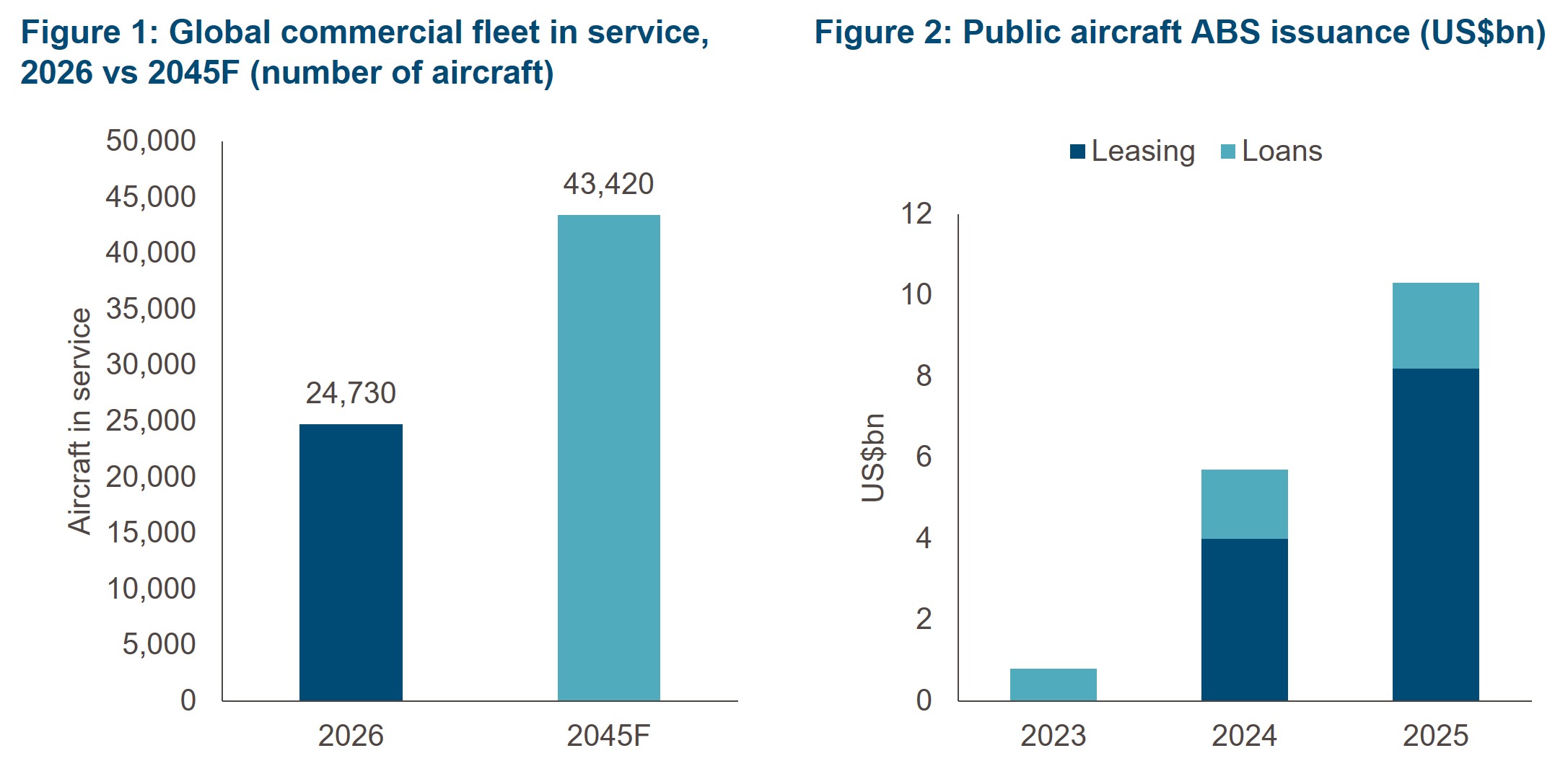
Commercial aircraft are among the world’s most valuable productive assets but acquiring them requires significant upfront investment. Rather than tying up capital in aircraft ownership, airlines rely on leasing companies, which acquire aircraft using a combination of third-party debt and equity before leasing them to operators under long-term contracts. With more than half of the global commercial fleet now owned by lessors, external financing has become fundamental to the way the industry operates.
This financing requirement is only likely to increase. Airlines need to replace ageing fleets, add capacity to meet passenger demand and invest in newer, more fuel-efficient aircraft. At the same time, lessors require significant amounts of capital to finance aircraft purchases and refinance existing portfolios.
Forecasts are not a reliable indicator of future results.
Figure 1 Source: Airbus Global Market Forecast, July 2026. F = forecast.
Figure 2 Source: Kroll Bond Rating Agency and Airfinance Global, as of 10 January 2026. Covers aircraft and engine leasing and loan transactions.
Together, these dynamics create a sizeable and recurring financing need, opening opportunities for institutional capital to play a greater role in an industry historically reliant on traditional lenders.
Contractual income backed by tangible assets
Aviation finance encompasses a range of strategies through which investors can provide debt or equity capital to support aircraft deliveries, fleet expansion, refinancing and portfolio acquisitions. For lenders, transactions are typically secured against the aircraft and, where applicable, associated lease receivables.
This asset backing is an important feature of the investment proposition. Investors are not simply assessing a company’s ability to meet its obligations; they are also analysing the value and characteristics of an identifiable underlying asset with low obsolescence risk.
That requires an assessment of aircraft type, age and maintenance condition, lease structure, residual value and secondary-market liquidity. The creditworthiness of the airline or lessor and the jurisdiction where the aircraft operates are also important, particularly when assessing the enforceability of security.
Should a borrower default, senior secured lenders have the ability, if required, to enforce their security, repossess the aircraft and seek to recover value through its sale or re-leasing. Commercial aircraft are also unique assets in that they are both globally mobile and supported by an established international leasing and secondary market.
In-demand aircraft can routinely be redeployed between airlines and geographies, reducing reliance on the fortunes of any single operator. The breadth of the potential operator base can therefore provide an additional layer of downside protection, particularly for widely used aircraft types with established maintenance infrastructure and strong demand from airlines globally.
For investors, the combination of contractual cashflows and security over tangible, income-producing assets can therefore offer an alternative source of income and provide diversification alongside more traditional fixed-income and private-market investments.
A structural need for capital
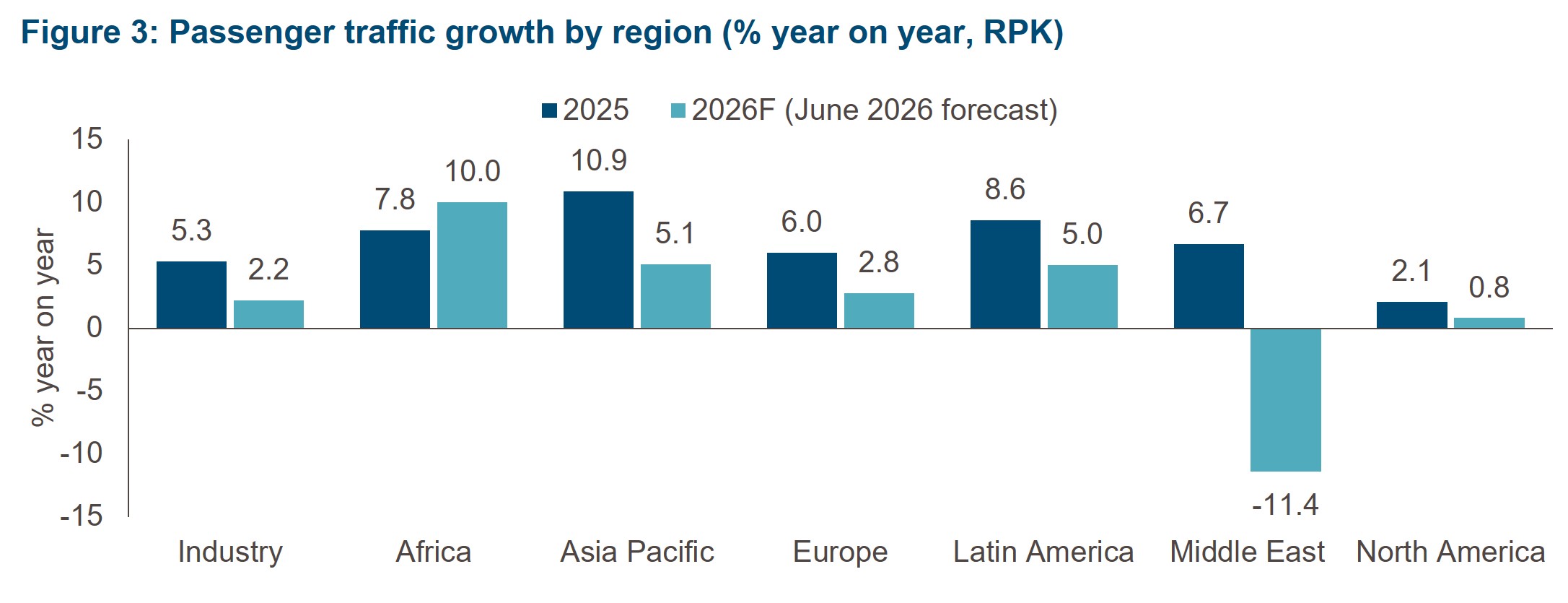
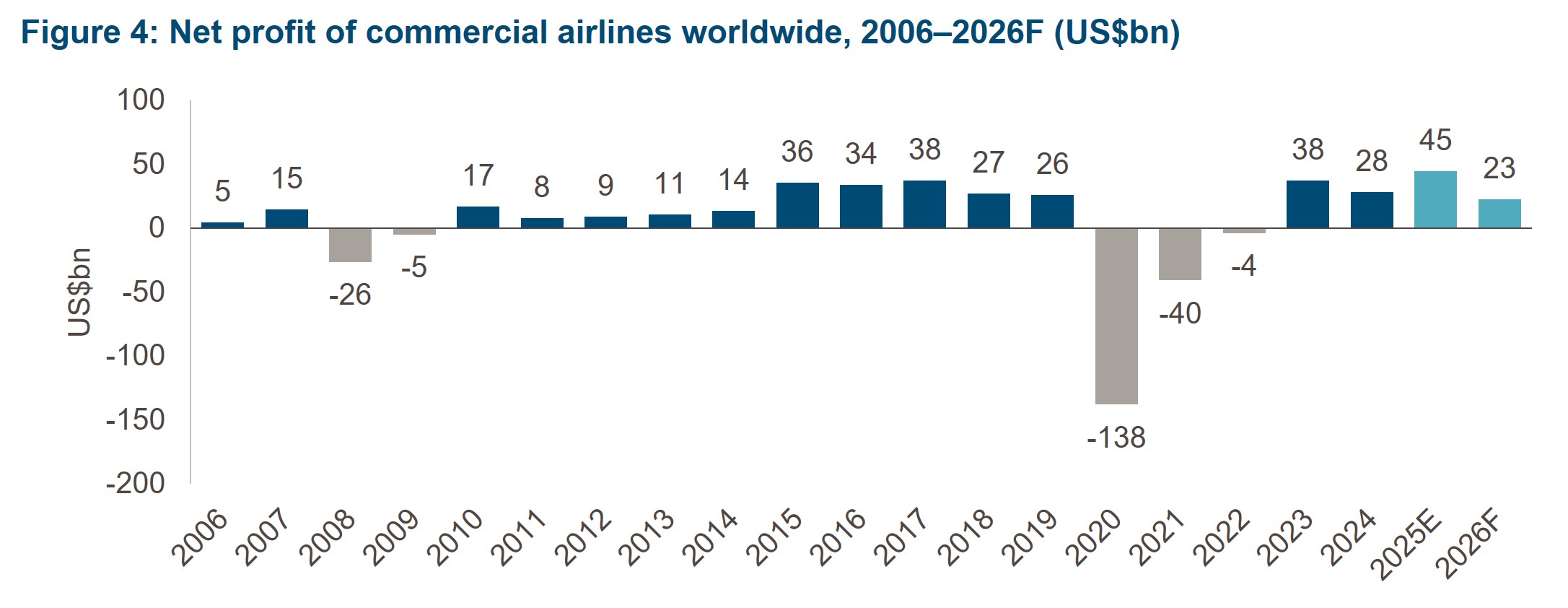
The current market backdrop is reinforcing the opportunity. Passenger demand has remained strong, despite macro headwinds in 2026. On July 23rd 2026, aviation experienced its busiest day ever with over 153,000 commercial flights recorded.1 This robust demand supports airline profitability and fleet utilisation, while aircraft supply remains exceptionally constrained.
Forecasts are not a reliable indicator of future results.
Source: IATA Global Outlook for Air Transport, June 2026. RPK = revenue passenger kilometres. F = forecast.
Forecasts are not a reliable indicator of future results.
Source: IATA Global Outlook for Air Transport, June 2026. E = estimate, F = forecast. Grey bars denote loss-making years; light blue bars denote estimates and forecasts.
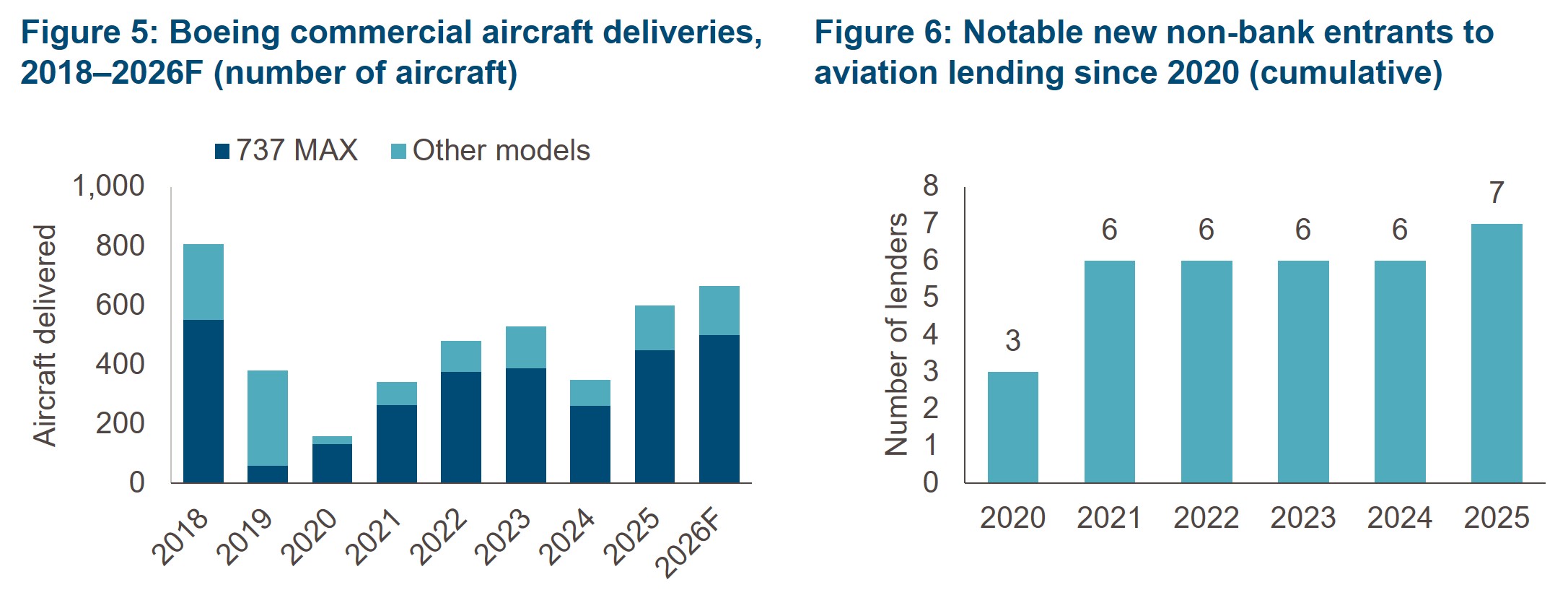
Airbus and Boeing have combined order backlogs exceeding 15,000 aircraft – representing more than a decade of production at current rates – while supply-chain constraints, manufacturing challenges and engine shortages continue to restrict the pace of new deliveries.
This imbalance has important implications for aircraft finance. Airlines cannot simply order additional aircraft and expect near-term delivery. They therefore need to make greater use of existing fleets and compete for available aircraft in the leasing market.
That scarcity has supported lease rates, utilisation and the value of existing aircraft, particularly newer, fuel-efficient narrow-body models. Aircraft values have recovered strongly from their COVID-era lows, strengthening the collateral underpinning many aviation finance transactions. With new aircraft difficult to secure, existing aircraft have become increasingly important in meeting airlines’ capacity requirements.
Forecasts are not a reliable indicator of future results.
Source: Boeing, as of June 2026. F = forecast.
Notable bank exits: DVB (2019); NAB (partial sale) and CIT Bank (2021); Standard Chartered (2023); Nord LB (2024); Hamburg Commercial Bank (2025). Source: Companies’ publicly available data; Muzinich analysis. References to specific companies are for illustrative purposes only.
Meanwhile, the sources of finance available to the industry are evolving. Banks remain important participants in the market, but the changing financing landscape is creating more room for alternative providers of capital.
Specialist private capital is filling an increasing proportion of this funding gap, particularly where borrowers value certainty of execution, flexibility or bespoke financing structures. Due to traditional lending capacity becoming more constrained, investors can potentially negotiate attractive pricing and stronger structural protections while maintaining disciplined underwriting standards.
The result, in our view, is a distinctive combination: a large and recurring requirement for capital, constrained aircraft supply, resilient collateral values and an evolving lender base.
Why specialist expertise matters
These characteristics do not make aviation finance without risk. The sector is cyclical and can be affected by economic downturns, geopolitical events, fuel prices, airline failures and unexpected disruptions to passenger travel. Aircraft values can fall, while repossession and remarketing may be complex, particularly across different legal jurisdictions.
Aircraft are also highly technical assets. Their value can vary significantly according to model, age, engine type, maintenance history and market demand. Two aircraft of a similar age can therefore present very different investment risks.
This makes specialist expertise critical. Investing successfully in aviation finance requires capabilities spanning fundamental credit analysis, aircraft valuation, lease structures, maintenance, legal jurisdictions and asset remarketing, alongside established relationships across airlines, lessors, manufacturers, banks and other industry participants.
These capabilities matter throughout the investment lifecycle: from sourcing transactions, assessing collateral and structuring protections to managing the asset and, where necessary, remarketing an aircraft if a borrower encounters difficulties. They can also help investors distinguish between opportunities where the potential return adequately compensates for the underlying risks and those where it does not.
A differentiated source of income and diversification
For investors considering how to diversify sources of portfolio income, aviation finance offers characteristics that differ from both conventional corporate credit and many other private-market investments.
Returns are linked not only to the creditworthiness of a borrower, but also to the contractual lease income and value of an underlying physical asset. At the same time, the fundamental drivers of the aviation market – including passenger demand, aircraft availability and fleet replacement – can differ from those influencing other areas of corporate credit.
As private capital continues to move into areas historically financed predominantly by banks, aviation provides an example of how the investment opportunity set is broadening.
For investors able to access the necessary specialist expertise, we believe aviation finance can offer a differentiated source of uncorrelated contractual income, hard-asset security and portfolio diversification, while providing capital to an industry with substantial long-term financing requirements.
This material is not intended to be relied upon as a forecast, research, or investment advice, and is not a recommendation, offer or solicitation to buy or sell any securities or to adopt any investment strategy. The opinions expressed by Muzinich & Co. are as of October 2026 and may change without notice.
References
1. Flightradar24, as of 2nd August 2026
--------
Important information
Muzinich and/or Muzinich & Co. referenced herein is defined as Muzinich & Co., Inc. and its affiliates. Muzinich views and opinions. This material has been produced for information purposes only and as such the views contained herein are not to be taken as investment advice. Opinions are as of date of publication and are subject to change without reference or notification to you. Past performance is not a reliable indicator of current or future results and should not be the sole factor of consideration when selecting a product or strategy. The value of investments and the income from them may fall as well as rise and is not guaranteed and investors may not get back the full amount invested. Rates of exchange may cause the value of investments to rise or fall.
Any research in this document has been obtained and may have been acted on by Muzinich for its own purpose. The results of such research are being made available for information purposes and no assurances are made as to their accuracy. Opinions and statements of financial market trends that are based on market conditions constitute our judgment and this judgment may prove to be wrong. The views and opinions expressed should not be construed as an offer to buy or sell or invitation to engage in any investment activity, they are for information purposes only.
This discussion material contains forward-looking statements, which give current expectations of future activities and future performance. Any or all forward-looking statements in this material may turn out to be incorrect. They can be affected by inaccurate assumptions or by known or unknown risks and uncertainties. Although the assumptions underlying the forward-looking statements contained herein are believed to be reasonable, any of the assumptions could be inaccurate and, therefore, there can be no assurances that the forward-looking statements included in this discussion material will prove to be accurate. In light of the significant uncertainties inherent in the forward-looking statements included herein, the inclusion of such information should not be regarded as a representation that the objectives and plans discussed herein will be achieved. Further, no person undertakes any obligation to revise such forward-looking statements to reflect events or circumstances after the date hereof or to reflect the occurrence of unanticipated events.
United Arab Emirates (UAE): This information is provided for discussion and informational purposes only and does not constitute an offer or solicitation in the UAE. It is intended solely for Professional Investors and should not be relied upon by any other person. This material has not been reviewed or approved by the UAE Securities and Commodities Authority, the UAE Central Bank or any other relevant authority. Nothing contained herein constitutes investment, legal, tax or other professional advice. Recipients should make their own independent assessment where appropriate.
Abu Dhabi Global Market (ADGM): This information is provided for discussion and informational purposes only and does not constitute an offer or solicitation in the ADGM. It is intended solely for Professional Clients (as defined by the Financial Services Regulatory Authority) and should not be relied upon by any other person. This material has not been reviewed or approved by the Financial Services Regulatory Authority or any other relevant authority in the UAE.
United States: This material is for Institutional Investor use only – not for retail distribution. Muzinich & Co., Inc. is a registered investment adviser with the Securities and Exchange Commission (SEC). Muzinich & Co., Inc.’s being a Registered Investment Adviser with the SEC in no way shall imply a certain level of skill or training or any authorization or approval by the SEC.
Issued in the European Union by Muzinich & Co. (Ireland) Limited, which is authorized and regulated by the Central Bank of Ireland. Registered in Ireland, Company Registration No. 307511. Registered address: 32 Molesworth Street, Dublin 2, D02 Y512, Ireland. Issued in Switzerland by Muzinich & Co. (Switzerland) AG. Registered in Switzerland No. CHE-389.422.108. Registered address: Tödistrasse 5, 8002 Zurich, Switzerland. Issued in Singapore and Hong Kong by Muzinich & Co. (Singapore) Pte. Limited, which is licensed and regulated by the Monetary Authority of Singapore. Registered in Singapore No. 201624477K. Registered address: 6 Battery Road, #26-05, Singapore, 049909. Issued in all other jurisdictions (excluding the U.S.) by Muzinich & Co. Limited. which is authorized and regulated by the Financial Conduct Authority. Registered in England and Wales No. 3852444. Registered address: 8 Hanover Street, London W1S 1YQ, United Kingdom. 2026-10-13-19630

By clicking "Submit", I am (i) signing up to receive the Opinion Pieces from the "Opinions" page of the Muzinich & Co website, (ii) representing that the above information is true and accurate and (iii) agreeing to join the Muzinich & Co mailing list. I understand that Muzinich & Co will not add retail investors or individuals with personal email addresses to its mailing list and represent that I am not a retail investor. By providing my personal and professional information I am consenting to its use and disclosure in accordance with the Muzinich & Co. Privacy Policy. I understand that I may withdraw my consent and unsubscribe from receiving future communications by clicking "Unsubscribe" from the emails that are sent to me from Muzinich & Co.

May 21, 2025
Lift off: The case for aviation finance in institutional portfolios
As traditional lenders retreat from aviation finance, Muzinich & Co. aviation portfolio managers Alok Wadhawan, Brian Lau and Thomas Light make the case for institutional investors to allocate to the asset class.

Nov 29, 2024
Aviation debt: Resilience, rates and the return of ABS
Robust demand for aircraft and the retreat of banks from the aviation debt market are creating opportunities for alternative lenders and their investors, as Alok Wadhawan and Brian Lau explain.

May 23, 2024
From recovery to resurgence: The outlook for aviation finance
In our latest Q&A, Alok Wadhawan and Tom Light share their thoughts on a remarkable turnaround in the aviation sector and the implications for investors.