Muzinich Weekly Market Comment: Center of Gravity
Insight
July 20, 2026
If you have any feedback on this article or are interested in subscribing to our content, please contact us at opinions@muzinich.com or fill out the form on the right hand side of this page.
--------
Second-quarter earnings season kicked off last week and seems to have done what the markets needed it to do: provide an anchor of company-specific fundamentals against a backdrop of geopolitical noise. Results from the major US banks set an encouraging tone, with better-than-feared results underscoring the resilience of the domestic consumer and corporate borrower alike1. The next thing to watch will be AI related companies and their earnings projections alongside their capital expenditure intentions.
This resilience was reinforced by softer-than-expected US inflation data (see Chart of the Week). Both June's Consumer Price Index (CPI) and Producer Price Index (PPI) came in below consensus, offering rates markets some relief and very likely taking a July 29th Federal Open Market Committee (FOMC) rate hike off the table2. The move lower in yields was a welcome development for a market that has spent much of this early summer pricing the risk of a policy mistake rather than debating the direction of travel. It also stands in some contrast to the picture in the euro area, where the European Central Bank (ECB) continues to weigh a still-elevated inflation impulse against early, tentative signs that German fiscal support could begin feeding through to final demand. For European investors, the divergence may raise the question of which central bank—the Fed or the ECB—is closer to being caught offside.
However, last week we also saw newly installed Chair Kevin Warsh testify on Capitol Hill with a somewhat more hawkish tone than the cooler inflation prints might have suggested3. The juxtaposition—soft data, hawkish messenger—could keep rates volatility elevated and affect the US Treasury curve. While the US Treasury curve bull steepened last week (as the softer June CPI print reassured markets on the disinflation path), the German curve bear flattened in contrast4. As a result, the spread between US and European government bonds tightened, ending the run of European bond outperformance versus US Treasurys seen over the past couple of months.
At the same time, a political premium could make a comeback in European bonds. In Italy, Meloni's contested electoral reform narrowly survived a setback in the lower house before ultimately passing, with the more difficult Senate vote still ahead5. In France, attention is turning early to the presidential election set for April 2027, after Marine Le Pen (Rassemblement National) declared herself a candidate, having been cleared of ineligibility by the appeal court6. It is too early to call a winner, but current polling puts her in a favorable position across most plausible scenarios.
Meanwhile, equity markets followed a rotation out of software and into AI infrastructure spending. The catalyst was arguably IBM, whose earnings significantly disappointed investors, sending the stock down 25% in a single session7. The reaction spilled over into other software-related names, as investors grew increasingly nervous that corporate spending is being reallocated away from traditional software services and toward AI infrastructure, a rotation that, until last week, had mostly been discussed as a future risk rather than a present one. European technology and software names were not immune, with the sell-off in US peers weighing on sentiment across the region's more richly valued growth stocks.
Away from earnings, activity data released last week pointed to a broadly resilient US economy, with early evidence that lower oil prices are beginning to show through to household and business activity. Whether that tailwind proves durable or merely transitory will likely depend on how long energy prices remain contained, particularly given the tenuous Middle East de-escalation that has weighed on markets in recent weeks.
Finally, a development that may prove more consequential over the medium term than last week's headlines suggest: Japan is exploring ways to encourage its own citizens to hold a greater share of Japanese government bonds (JGBs)8. The implications extend well beyond Tokyo. A structural shift toward more domestic ownership of JGBs could, at the margin, mean less Japanese demand for other developed-market government bonds—a meaningful consideration given Japan's position as the largest foreign holder of US Treasurys, at over $1.1 trillion, and a consistent, if smaller, buyer of European government bonds, including Gilts and Bunds.
Taken together, last week the market's center of gravity shifted more than once: from geopolitics to earnings, from rate hikes to rate cuts, and from software to AI infrastructure, to whatever might come next.
Chart of the Week: Better than Expected US Inflation Data
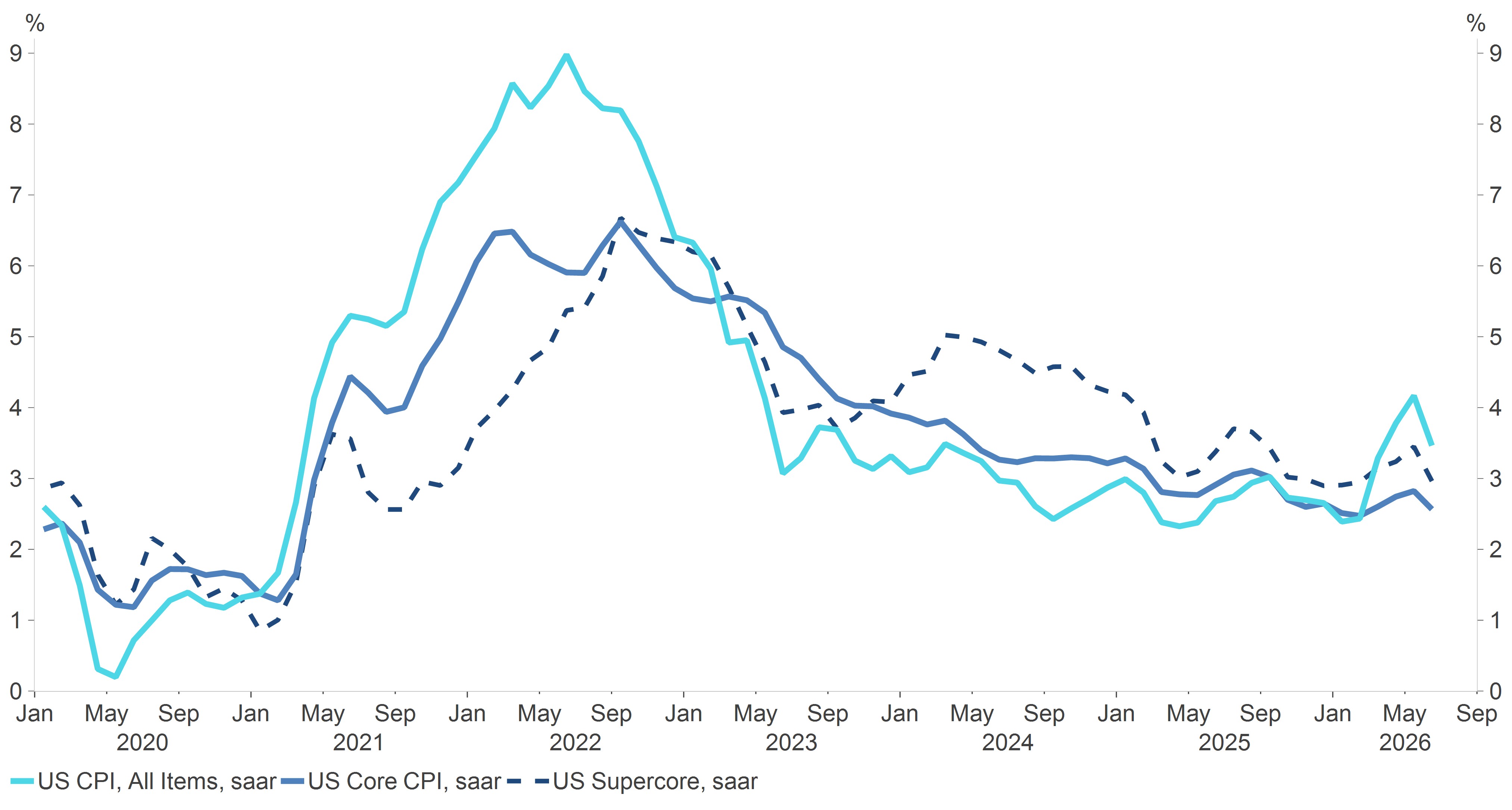 Source: U.S. Bureau of Labor Statistics, as of July 14, 2026. Muzinich views and opinions are subject to change. For illustrative purposes only, not to be construed as investment advice or an invitation to engage in any investment activity.
Past performance is not a reliable indicator of current or future results.
References to specific companies is for illustrative purposes only and does not reflect the holdings of any specific past or current portfolio or account.
References
1. Reuters, “JPMorgan posts highest quarterly profit ever by a U.S. bank as dealmaking, stock trading surge,” July 14, 2026
2.U.S. Bureau of Labor Statistics, CPI and PPI releases, July 14–15, 2026; CME Group FedWatch Tool, as of July 15, 2026
3.CNN Business, “Latest improvement on inflation isn’t ‘mission accomplished,’ Fed Chairman Warsh says,” June 14, 2026
4.Reuters, “Euro zone yields rise, gap between German and US borrowing costs smallest in a month,” July 16, 2026
5.Reuters, “Italy’s parliament backs Meloni’s contested electoral reform,” July 16, 2026
6.Reuters, "Marine Le Pen's Presidential Bid Hinges on French Court Verdict," July 7, 2026
7.Reuters via The Globe and Mail, “An ugly moment for IBM and software stocks’: Big Blue shares suffer their biggest ever one-day plunge after earnings warning,” July 14, 2026
8.France 24, “What to know about the electronic monitor Marine Le Pen must wear,” July 7, 2026
This material is not intended to be relied upon as a forecast, research, or investment advice, and is not a recommendation, offer or solicitation to buy or sell any securities or to adopt any investment strategy. The opinions expressed by Muzinich & Co. are as of July 17, 2026, and may change without notice. All data figures are from Bloomberg, as of July 17, 2026, unless otherwise stated.
--------
Important information
Muzinich & Co., “Muzinich” and/or the “Firm” referenced herein is defined as Muzinich & Co. Inc. and its affiliates. This material has been produced for information purposes only and as such the views contained herein are not to be taken as investment advice. Opinions are as of date of publication and are subject to change without reference or notification to you. Past performance is not a reliable indicator of current or future results and should not be the sole factor of consideration when selecting a product or strategy. The value of investments and the income from them may fall as well as rise and is not guaranteed and investors may not get back the full amount invested. Rates of exchange may cause the value of investments to rise or fall. Emerging Markets may be more risky than more developed markets for a variety of reasons, including but not limited to, increased political, social and economic instability, heightened pricing volatility and reduced market liquidity. Any research in this document has been obtained and may have been acted on by Muzinich for its own purpose. The results of such research are being made available for information purposes and no assurances are made as to their accuracy. Opinions and statements of financial market trends that are based on market conditions constitute our judgment and this judgment may prove to be wrong. The views and opinions expressed should not be construed as an offer to buy or sell or invitation to engage in any investment activity, they are for information purposes only. Any forward-looking information or statements expressed in the above may prove to be incorrect. In light of the significant uncertainties inherent in the forward-looking statements included herein, the inclusion of such information should not be regarded as a representation that the objectives and plans discussed herein will be achieved. Muzinich gives no undertaking that it shall update any of the information, data and opinions contained in the above.
United States: This material is for Institutional Investor use only – not for retail distribution. Muzinich & Co., Inc. is a registered investment adviser with the Securities and Exchange Commission (SEC). Muzinich & Co., Inc.’s being a Registered Investment Adviser with the SEC in no way shall imply a certain level of skill or training or any authorization or approval by the SEC.
United Arab Emirates (UAE): This information is provided for discussion and informational purposes only and does not constitute an offer or solicitation in the UAE. It is intended solely for Professional Investors and should not be relied upon by any other person. This material has not been reviewed or approved by the UAE Securities and Commodities Authority, the UAE Central Bank or any other relevant authority. Nothing contained herein constitutes investment, legal, tax or other professional advice. Recipients should make their own independent assessment where appropriate.
Abu Dhabi Global Market (ADGM): This information is provided for discussion and informational purposes only and does not constitute an offer or solicitation in the ADGM. It is intended solely for Professional Clients (as defined by the Financial Services Regulatory Authority) and should not be relied upon by any other person. This material has not been reviewed or approved by the Financial Services Regulatory Authority or any other relevant authority in the UAE.
Issued in the European Union by Muzinich & Co. (Ireland) Limited, which is authorized and regulated by the Central Bank of Ireland. Registered in Ireland, Company Registration No. 307511. Registered address: 32 Molesworth Street, Dublin 2, D02 Y512, Ireland. Issued in Switzerland by Muzinich & Co. (Switzerland) AG. Registered in Switzerland No. CHE-389.422.108. Registered address: Tödistrasse 5, 8002 Zurich, Switzerland. Issued in Singapore and Hong Kong by Muzinich & Co. (Singapore) Pte. Limited, which is licensed and regulated by the Monetary Authority of Singapore. Registered in Singapore No. 201624477K. Registered address: 6 Battery Road, #26-05, Singapore, 049909. Issued in all other jurisdictions (excluding the U.S.) by Muzinich & Co. Limited. which is authorized and regulated by the Financial Conduct Authority. Registered in England and Wales No. 3852444. Registered address: 8 Hanover Street, London W1S 1YQ, United Kingdom.

By clicking "Submit", I am (i) signing up to receive the Opinion Pieces from the "Opinions" page of the Muzinich & Co website, (ii) representing that the above information is true and accurate and (iii) agreeing to join the Muzinich & Co mailing list. I understand that Muzinich & Co will not add retail investors or individuals with personal email addresses to its mailing list and represent that I am not a retail investor. By providing my personal and professional information I am consenting to its use and disclosure in accordance with the Muzinich & Co. Privacy Policy. I understand that I may withdraw my consent and unsubscribe from receiving future communications by clicking "Unsubscribe" from the emails that are sent to me from Muzinich & Co.