Muzinich Weekly Market Comment: Running up a down escalator
Insight
August 24, 2026
If you have any feedback on this article or are interested in subscribing to our content, please contact us at opinions@muzinich.com or fill out the form on the right hand side of this page.
--------
Robust European data is being overshadowed by geopolitical tensions and rising sovereign yields. With governments and corporates competing for investor capital and uncertainty pushing up term premia, we believe the short end of emerging market debt and high yield offers a way to capture resilient growth and corporate earnings while limiting exposure to long-duration risk.
Last week, typically one of the quietest weeks of the year, markets traded with a softer tone across risk assets. The continued stalemate in Iran negotiations pushed crude prices higher, while robust economic data in Europe largely went unnoticed. Headlines from the US Treasury took center stage, leaving the US dollar softer against most major currencies as the week closed.
Investors are still waiting for details of what Donald Trump has billed as an unprecedented campaign of economic warfare against Iran, including a threat to target Tehran’s trading partners after talks collapsed. Iran’s top trading partners include China, the United Arab Emirates (UAE), Iraq, Türkiye, India, Pakistan, Afghanistan, South Korea, Germany and the Netherlands, with China by far the dominant partner on both sides of the trade relationship. While the importance of the UAE should not be underestimated, it has long served as Iran’s main re-export and financial gateway, making this week’s decision by the UAE to suspend all trade and financial dealings with Tehran a significant blow. The move came after what the UAE said were two Iranian ballistic missiles fired at its territory.[1]
Across Europe, another week of largely overlooked, robust economic activity data came in the form of Purchasing Managers’ Index (PMI) reports. The euro-area composite PMI rose to 52.1 in August, a 9-month high and above the median forecast of 51.7 among economists surveyed. The sectoral breakdown points to broad-based strength, with manufacturing expanding at a fast pace while services growth held steady. The August PMI suggests that the strong momentum seen in the second quarter, when euro-area GDP grew by a robust 0.4%, has carried into the third quarter.[2] Indeed, the scale of the upside surprise is striking. The Citi Economic Surprise Index has swung from roughly -80 in the spring to +78, one of the sharpest reversals in 5 years and its highest reading since early 2023. In our view, economists have been too pessimistic. See Chart of the Week.
The UK’s August PMI also signaled ongoing economic resilience, with the composite PMI rising to 52.5 from 52.2 in July. The boost to activity was led by the services sector, with respondents citing higher business and consumer spending. Historical mapping of PMI to GDP data suggests this reading would be consistent with 0.2% GDP growth in Q3 2026.[3]
In the US, the Federal Open Market Committee’s (FOMC’s) July minutes reinforced the Chair’s hawkish message at the press conference. But it was an announcement from the Treasury Department that really captured investors’ attention. In a post on its website, the Treasury said it would increase – by at least double – the size of its liquidity-support buyback operations for longer-dated nominal coupon securities, covering the 10-year to 20-year and 20-year to 30-year sectors. This means the current maximum of US$2 billion per operation will rise to at least US$4 billion per operation.[4]
Treasury Secretary Scott Bessent, who has fondly described his job as that of the nation’s top bond salesman, has acted in recent weeks to cap US government bond yields, or at least slow their rise.
He staged the first US currency intervention to prop up the yen since 1998. The move was framed as helping an ally, but it also eases pressure on Japan’s bond market, where rising yields have contributed to the recent selloff in Treasuries, and it reduces Japan’s need to sell US government bonds to raise the dollars required to defend its currency on its own. He went further by pointing to a Federal Reserve (Fed) facility that Tokyo could tap in the future, advocating an expansion of the Fed’s Foreign and International Monetary Authorities (FIMA) Repo Facility, which lets eligible foreign central banks temporarily swap Treasury holdings for US dollars with the Fed rather than selling those holdings into the market.[5]
Then within the quarterly refunding announcement, a subtle and unexpected change to the department’s guidance was interpreted as opening the door to fewer long-bond sales. After the buyback announcement, Bessent made it clear that the Treasury has a "big toolkit" for the Treasury market and investors shouldn’t underestimate the buybacks programme. He also signaled that the administration would announce an increased focus on fiscal consolidation, though he offered little further detail.[6]
Thirty-year US Treasury yields rose to 5.3% at the start of the week, their highest level since 2007, but it isn’t just the US facing a surge in borrowing costs. Sovereign yields are rising around the world. French borrowing costs have reached levels last seen in 2008, while German yields are trading at levels not seen since 2011. In the UK, gilt yields have approached 6%, which would be their highest level in a quarter of a century, while comparable Japanese long-term yields are close to their all-time high, having broken above 4% for the first time.
It isn’t difficult to list the reasons why government yield curves are bear-steepening. In fact, attempting to cap yields at present feels like running up a down escalator. Economists would point to persistent geopolitical turmoil, which is making economies more vulnerable to supply shocks and inflationary pressures, combined with a broad-based global earnings upcycle underpinned by full employment and a generational capex cycle.
Investors’ concerns center on the withdrawal of central bank guidance, which shifts more uncertainty onto their shoulders and pushes up the term premium. By withdrawing that guidance, the Fed is effectively canceling the insurance policy it had provided. Uncertainty is being transferred back to investors, who demand greater compensation for the risks against which they are no longer insured.
Meanwhile, central banks seem to be concerned with the changing dynamics of defined-contribution pension schemes and the shift in the investor base over the past several years from relatively price-insensitive official-sector holders towards more price-sensitive private investors, a concern the FOMC highlighted in its June meeting.[7]
Market technicians are pointing to the growing crowding-out effect. Last week, the US government’s stock of debt crossed US$40 trillion,[8] and to fund it, the Treasury is increasingly competing for investors with corporate borrowers, many of which are seen as having stronger balance sheets than the government itself. US investment grade bond sales, led in part by technology firms financing the AI buildout, have just set a third consecutive monthly record, with August supply reaching US$145.2 billion. Year-to-date issuance has reached US$1.46 trillion, running 8.5% ahead of the pace set in 2020, the pandemic year that still holds the full-year record.[9] Between sovereign and corporate supply, a great deal of duration is being pushed into a market that is already struggling to absorb it.
However, if there is one concern on which everyone could now agree, it is the need to rein in fiscal largesse. The pressure is global. Defence budgets are rising across the world; there are fears of expansionary policy in Japan; political divisions are preventing the adoption of a 2027 budget before the presidential elections in France; the UK is retreating from its fiscal rule; and there is the question of why the US is running a 6% deficit in an economy at full employment. With two months of the fiscal year still to go, the FY2026 deficit stands at US$1.8 trillion, 10% wider than at the same point last year and already larger than the entire FY2025 shortfall. Spending is being propelled by Social Security, Medicare, Medicaid and interest on the debt.[10]
For bond investors, we believe the answer lies at the short end of emerging market debt and high yield. It sidesteps deteriorating sovereign balance sheets and the oversupply at the long end, limits exposure to central bank and geopolitical uncertainty, and captures the global uplift in corporate earnings, resilient growth, and the pull-to-par dynamics of the asset class.
Chart of the Week: Positive Economic Activity in Europe
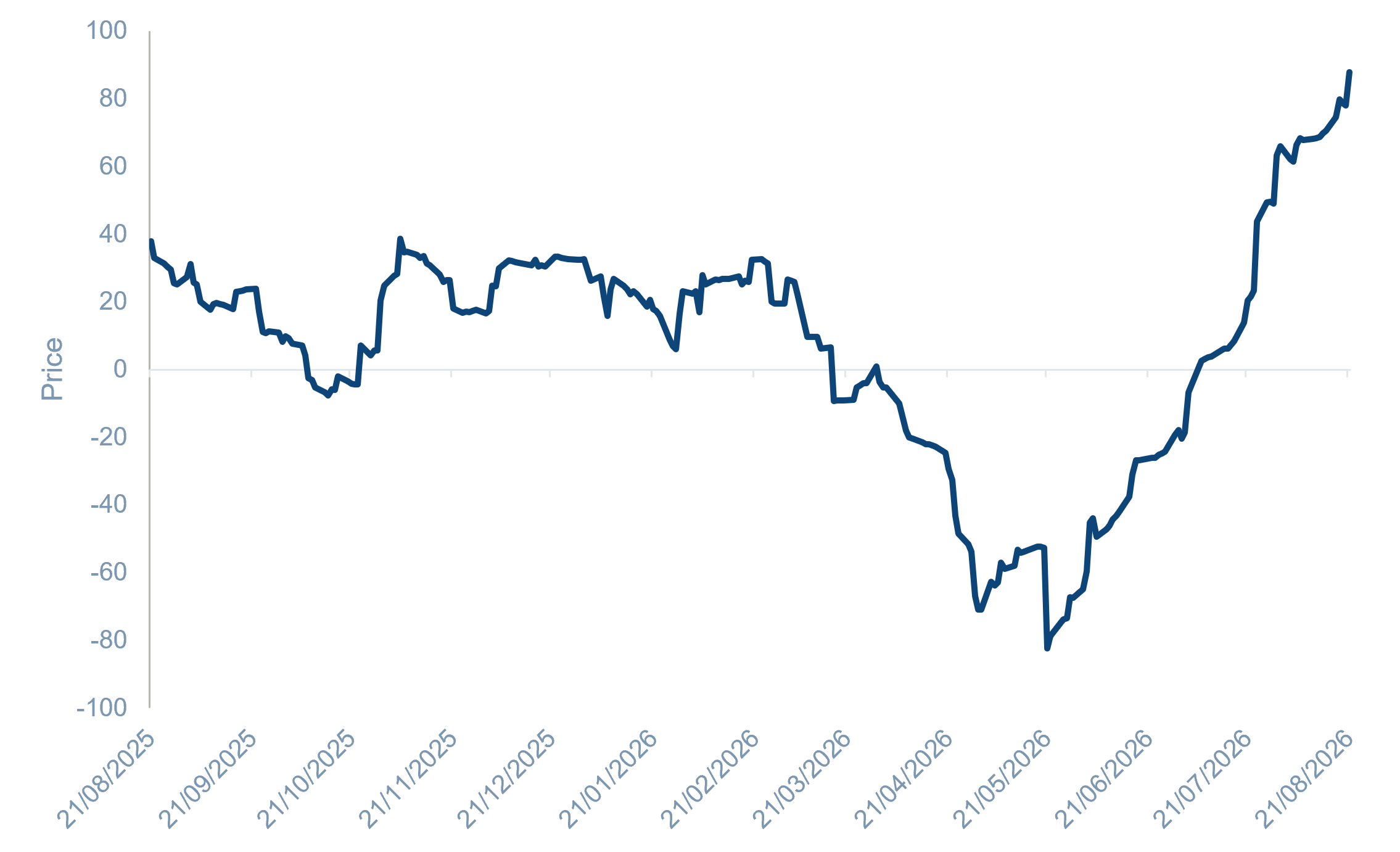
Source: Bloomberg, as of August 21, 2026. Muzinich views and opinions are subject to change. For illustrative purposes only, not to be construed as investment advice or an invitation to engage in any investment activity.
Past performance is not a reliable indicator of current or future results.
References to specific companies is for illustrative purposes only and does not reflect the holdings of any specific past or current portfolio or account.
References
[1] BBC Monitoring, “Explainer: UAE suspension of trade ties raises pressure on Iran’s economy,” August 21, 2026
[2] Bloomberg, “EURO-AREA REACT: Further PMI Rise Points to Solid 3Q Growth,” August 21, 2026
[3] Bloomberg, “UK REACT: PMI Shows Resilience, Hot Prices Keep BOE on Toes,” August 21, 2026
[4] US Department of the Treasury, “Press Release: Treasury Announces Increased Sizes of Nominal Long-End Liquidity Support Buybacks Beginning September 9,” August 19. 2026
[5] Bloomberg, “Behind Bessent Moves, Wall Street Sees a Bond-Market Angst,” August 10, 2026
[6] Bloomberg, “Bessent Flags Bigger Debt Buyback Potential, Coming Fiscal Plan,” August 20, 2026
[7] Minutes of the Federal Open Market Committee (FOMC), June 16-17, 2026
[8] FiscalDataTreasury.gov, “Debt to the Penny,” August 21, 2026
[9] Bloomberg, “US High-Grade Bond Sales Set August Record in Year Full of Them,” August 17, 2026
[10] Peter G. Peterson Foundation, “Current Federal Debt and Deficit,” as of August 21, 2026
This material is not intended to be relied upon as a forecast, research, or investment advice, and is not a recommendation, offer or solicitation to buy or sell any securities or to adopt any investment strategy. The opinions expressed by Muzinich & Co. are as of August 21, 2026, and may change without notice. All data figures are from Bloomberg, as of August 21, 2026, unless otherwise stated.
--------
Important Information
Muzinich & Co., “Muzinich” and/or the “Firm” referenced herein is defined as Muzinich & Co. Inc. and its affiliates. This material has been produced for information purposes only and as such the views contained herein are not to be taken as investment advice. Opinions are as of date of publication and are subject to change without reference or notification to you. Past performance is not a reliable indicator of current or future results and should not be the sole factor of consideration when selecting a product or strategy. The value of investments and the income from them may fall as well as rise and is not guaranteed and investors may not get back the full amount invested. Rates of exchange may cause the value of investments to rise or fall. Emerging Markets may be more risky than more developed markets for a variety of reasons, including but not limited to, increased political, social and economic instability, heightened pricing volatility and reduced market liquidity. Any research in this document has been obtained and may have been acted on by Muzinich for its own purpose. The results of such research are being made available for information purposes and no assurances are made as to their accuracy. Opinions and statements of financial market trends that are based on market conditions constitute our judgment and this judgment may prove to be wrong. The views and opinions expressed should not be construed as an offer to buy or sell or invitation to engage in any investment activity, they are for information purposes only. Any forward-looking information or statements expressed in the above may prove to be incorrect. In light of the significant uncertainties inherent in the forward-looking statements included herein, the inclusion of such information should not be regarded as a representation that the objectives and plans discussed herein will be achieved. Muzinich gives no undertaking that it shall update any of the information, data and opinions contained in the above.
United Arab Emirates (UAE): This information is provided for discussion and informational purposes only and does not constitute an offer or solicitation in the UAE. It is intended solely for Professional Investors and should not be relied upon by any other person. This material has not been reviewed or approved by the UAE Securities and Commodities Authority, the UAE Central Bank or any other relevant authority. Nothing contained herein constitutes investment, legal, tax or other professional advice. Recipients should make their own independent assessment where appropriate.
Abu Dhabi Global Market (ADGM): This information is provided for discussion and informational purposes only and does not constitute an offer or solicitation in the ADGM. It is intended solely for Professional Clients (as defined by the Financial Services Regulatory Authority) and should not be relied upon by any other person. This material has not been reviewed or approved by the Financial Services Regulatory Authority or any other relevant authority in the UAE.
United States: This material is for Institutional Investor use only – not for retail distribution. Muzinich & Co., Inc. is a registered investment adviser with the Securities and Exchange Commission (SEC). Muzinich & Co., Inc.’s being a Registered Investment Adviser with the SEC in no way shall imply a certain level of skill or training or any authorization or approval by the SEC.
Issued in the European Union by Muzinich & Co. (Ireland) Limited, which is authorized and regulated by the Central Bank of Ireland. Registered in Ireland, Company Registration No. 307511. Registered address: 32 Molesworth Street, Dublin 2, D02 Y512, Ireland. Issued in Switzerland by Muzinich & Co. (Switzerland) AG. Registered in Switzerland No. CHE-389.422.108. Registered address: Tödistrasse 5, 8002 Zurich, Switzerland. Issued in Singapore and Hong Kong by Muzinich & Co. (Singapore) Pte. Limited, which is licensed and regulated by the Monetary Authority of Singapore. Registered in Singapore No. 201624477K. Registered address: 6 Battery Road, #26-05, Singapore, 049909. Issued in all other jurisdictions (excluding the U.S.) by Muzinich & Co. Limited. which is authorized and regulated by the Financial Conduct Authority. Registered in England and Wales No. 3852444. Registered address: 8 Hanover Street, London W1S 1YQ, United Kingdom.

By clicking "Submit", I am (i) signing up to receive the Opinion Pieces from the "Opinions" page of the Muzinich & Co website, (ii) representing that the above information is true and accurate and (iii) agreeing to join the Muzinich & Co mailing list. I understand that Muzinich & Co will not add retail investors or individuals with personal email addresses to its mailing list and represent that I am not a retail investor. By providing my personal and professional information I am consenting to its use and disclosure in accordance with the Muzinich & Co. Privacy Policy. I understand that I may withdraw my consent and unsubscribe from receiving future communications by clicking "Unsubscribe" from the emails that are sent to me from Muzinich & Co.