Muzinich Weekly Market Comment: Fire
Insight
July 27, 2026
If you have any feedback on this article or are interested in subscribing to our content, please contact us at opinions@muzinich.com or fill out the form on the right hand side of this page.
--------
Wildfires, geopolitical tensions and renewed questions over AI investment unsettled markets this week, driving higher oil prices and bond yields while exposing clear differences across credit markets.
As seasonal wildfires spread across Europe, Spain declared a state of emergency and deployed the military to contain the blazes, while France evacuated thousands of tourists threatened by a fire near Bordeaux. More than 300,000 hectares have burned across the continent so far.1 Across the Atlantic, however, a different kind of fire was being stoked, reigniting concerns over the military operation in Iran and the viability of AI business models.
Across the Middle East, the US Central Command launched 13 consecutive nights of strikes intended to degrade Iran’s ability to attack commercial shipping in Hormuz. Unfortunately, the memorandum of understanding and ceasefire framework is no longer in place, with both sides reverting to their aggressive verbal tit-for-tat. In a Truth Social post on Thursday, Trump threatened "major military punishment" against Iran and the Houthi militant group it backs in Yemen, and he told Axios he was "close to making a decision" on strikes that would be "bigger than ever before".2
The clearest beneficiary of the flare-up in the Middle East has been energy prices. Brent crude briefly breached the psychological US$100-a-barrel level before retreating, closing the week up more than 9%. Fixed income, by contrast, had a miserable time. Government bond curves bear-flattened as investors adjusted policy expectations amid renewed concern that inflationary pressure was returning. The US curve underperformed its main peers, with the 2-year Treasury yield rising 13 basis points (bps) versus gains of 8.5bps, 3.5bps, and 6bps for the Japanese, UK, and German 2-years respectively.
In recent times, it has been the long end of the Japanese curve that has been most volatile, as investors weighed fiscal fears and a central bank seen as falling further behind the curve. The front end, by contrast, had stayed anchored by a strong consensus that the Bank of Japan (BoJ) would adjust policy in line with its semi-annual bias, in 25bps steps, with the next move pencilled in for December. This week, however, BoJ officials were reported to be open to raising rates at a faster pace than the consensus among economists, as the yen's continued weakness adds to upside inflation risks.3
Given its sensitivity to energy prices as an importer, it may at first glance seem surprising to see the European bond market outperforming on a relative basis. But this week's European Central Bank (ECB) meeting saw the committee keep its policy rates unchanged, leaving the deposit rate at 2.25% as expected. Policymakers dampened bond yields by avoiding any signal of extending the hiking cycle beyond September. The accompanying policy communication hinted at another hike in September while doing little to endorse tightening beyond that. President Christine Lagarde struck a similar tone in the press conference, noting that some members had raised the prospect of hiking as soon as this month, hinting at a move in September, but acknowledged that the ECB sees no signs of second-round effects yet – suggesting nothing beyond the next move is written in stone.4
In the UK, meanwhile, the fire in gilt yields was dampened after June's Consumer Price Index (CPI) data surprised on the downside. Headline inflation fell more than expected to 2.6%, against the 2.7% consensus. Fuel prices were the main source of downward pressure, falling 3.1% on the month, while services inflation eased to 3.6%, in line with the Bank of England's expectations.5 Adding further water to the flames, new Prime Minister Andy Burnham - the seventh in a decade - sprang a surprise by naming John Healey as Chancellor of the Exchequer. Although an unexpected choice, Healey's previous experience as a treasury minister in the 2000s and his commitment to the government's fiscal rules helped reassure investors, supporting gilt sentiment.
For corporate credit, high yield outperformed its investment grade peers, shielded by its lower sensitivity to government yields and its higher coupons. The flames of uncertainty did tick up - our preferred gauge, the VIX, drifted up to 18 - but the 20 level, which has historically marked the point at which credit spreads begin to widen, was not breached. In fact, emerging market (EM) high yield closed the week tighter on a spread basis. US investment grade, by contrast, underperformed, weighed down by the sell-off in US Treasuries and its long-duration profile, combined with its closer linkage to AI and the hyperscalers, the other blaze burning over the week.
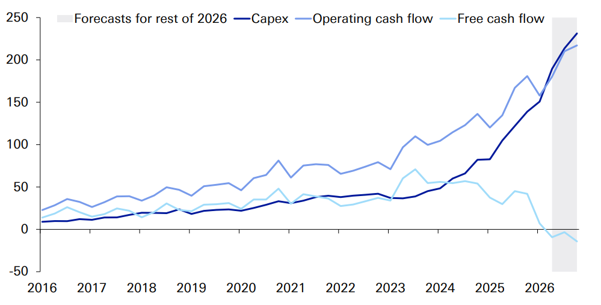
Although the fires in technology are not new, they still come back to two issues. The first is capex. Alphabet's Google, Microsoft, Amazon, Meta and Oracle are set to spend about US$700bn building AI capacity this year, up roughly 70% on last year,6 and this is no longer being funded out of free cash flow (see Chart of the Week).7 This points to a marginal weakening in balance sheets and greater bond supply. The second flame is the debate over whether cheaper open-source AI threatens the business model of the US AI-stack, which could erode the scarcity premium embedded in proprietary models, tightening margins and lowering barriers to entry.
Finally, equity markets, like corporate high yield, held up, with the Bloomberg World Large & Mid Cap index closing broadly unchanged on the week. US equities did underperform their European peers, as the US sits closer to both the rising rate and technology flames, with the Magnificent 7 down 5% over the week.
Chart of the Week: The 5 large US hyperscalers are now spending more on Capex than their combined operating cash flow
 Source: Deutsche Bank Research, “Charts to make you go WOW!!! 2026,” July 2026. Muzinich views and opinions are subject to change. For illustrative purposes only, not to be construed as investment advice or an invitation to engage in any investment activity.
Past performance is not a reliable indicator of current or future results.
References to specific companies is for illustrative purposes only and does not reflect the holdings of any specific past or current portfolio or account.
This material is not intended to be relied upon as a forecast, research, or investment advice, and is not a recommendation, offer or solicitation to buy or sell any securities or to adopt any investment strategy. The opinions expressed by Muzinich & Co. are as of July 24, 2026, and may change without notice. All data figures are from Bloomberg, as of July 24, 2026, unless otherwise stated.
References
1. Bloomberg, “Madrid Menaced by Wildfires as France’s Cap Ferret Evacuated,” July 24, 20262.
2. Bloomberg, “Trump Weighs Wider Iranian Attacks with New Truce Still Elusive,” July 24, 2026
3. Bloomberg, “BoJ Is Said Open to Faster Rate Hike Pace as Yen Adds Risks,” July 22, 2026
4. Bloomberg, “ECB REACT: Another Hike Coming in September After July Pause,” July 23, 2026
5. Bloomberg, “UK REACT: Soft CPI Gives BOE Cover to Hold as Oil Risks Rise,” July 22, 2026
6. Deutsche Bank Research Institute, “Open source AI 101: the battle for the future of AI,” July 21, 2026.
7. Deutsche Bank Research, “Charts to make you go WOW!!! 2026,” July 2026
--------
Important information
Muzinich & Co., “Muzinich” and/or the “Firm” referenced herein is defined as Muzinich & Co. Inc. and its affiliates. This material has been produced for information purposes only and as such the views contained herein are not to be taken as investment advice. Opinions are as of date of publication and are subject to change without reference or notification to you. Past performance is not a reliable indicator of current or future results and should not be the sole factor of consideration when selecting a product or strategy. The value of investments and the income from them may fall as well as rise and is not guaranteed and investors may not get back the full amount invested. Rates of exchange may cause the value of investments to rise or fall. Emerging Markets may be more risky than more developed markets for a variety of reasons, including but not limited to, increased political, social and economic instability, heightened pricing volatility and reduced market liquidity. Any research in this document has been obtained and may have been acted on by Muzinich for its own purpose. The results of such research are being made available for information purposes and no assurances are made as to their accuracy. Opinions and statements of financial market trends that are based on market conditions constitute our judgment and this judgment may prove to be wrong. The views and opinions expressed should not be construed as an offer to buy or sell or invitation to engage in any investment activity, they are for information purposes only. Any forward-looking information or statements expressed in the above may prove to be incorrect. In light of the significant uncertainties inherent in the forward-looking statements included herein, the inclusion of such information should not be regarded as a representation that the objectives and plans discussed herein will be achieved. Muzinich gives no undertaking that it shall update any of the information, data and opinions contained in the above.
United States: This material is for Institutional Investor use only – not for retail distribution. Muzinich & Co., Inc. is a registered investment adviser with the Securities and Exchange Commission (SEC). Muzinich & Co., Inc.’s being a Registered Investment Adviser with the SEC in no way shall imply a certain level of skill or training or any authorization or approval by the SEC.
United Arab Emirates (UAE): This information is provided for discussion and informational purposes only and does not constitute an offer or solicitation in the UAE. It is intended solely for Professional Investors and should not be relied upon by any other person. This material has not been reviewed or approved by the UAE Securities and Commodities Authority, the UAE Central Bank or any other relevant authority. Nothing contained herein constitutes investment, legal, tax or other professional advice. Recipients should make their own independent assessment where appropriate.
Abu Dhabi Global Market (ADGM): This information is provided for discussion and informational purposes only and does not constitute an offer or solicitation in the ADGM. It is intended solely for Professional Clients (as defined by the Financial Services Regulatory Authority) and should not be relied upon by any other person. This material has not been reviewed or approved by the Financial Services Regulatory Authority or any other relevant authority in the UAE.
Issued in the European Union by Muzinich & Co. (Ireland) Limited, which is authorized and regulated by the Central Bank of Ireland. Registered in Ireland, Company Registration No. 307511. Registered address: 32 Molesworth Street, Dublin 2, D02 Y512, Ireland. Issued in Switzerland by Muzinich & Co. (Switzerland) AG. Registered in Switzerland No. CHE-389.422.108. Registered address: Tödistrasse 5, 8002 Zurich, Switzerland. Issued in Singapore and Hong Kong by Muzinich & Co. (Singapore) Pte. Limited, which is licensed and regulated by the Monetary Authority of Singapore. Registered in Singapore No. 201624477K. Registered address: 6 Battery Road, #26-05, Singapore, 049909. Issued in all other jurisdictions (excluding the U.S.) by Muzinich & Co. Limited. which is authorized and regulated by the Financial Conduct Authority. Registered in England and Wales No. 3852444. Registered address: 8 Hanover Street, London W1S 1YQ, United Kingdom.2026-07-27-19087

By clicking "Submit", I am (i) signing up to receive the Opinion Pieces from the "Opinions" page of the Muzinich & Co website, (ii) representing that the above information is true and accurate and (iii) agreeing to join the Muzinich & Co mailing list. I understand that Muzinich & Co will not add retail investors or individuals with personal email addresses to its mailing list and represent that I am not a retail investor. By providing my personal and professional information I am consenting to its use and disclosure in accordance with the Muzinich & Co. Privacy Policy. I understand that I may withdraw my consent and unsubscribe from receiving future communications by clicking "Unsubscribe" from the emails that are sent to me from Muzinich & Co.