Muzinich Weekly Market Comment: Europe’s Widening Sovereign Divide
Insight
October 5, 2026
If you have any feedback on this article or are interested in subscribing to our content, please contact us at opinions@muzinich.com or fill out the form on the right hand side of this page.
--------
Rising bond yields are exposing growing divergence within European sovereign markets, as fiscal concerns drive spreads wider against Germany. While volatility is also weighing on credit, resilient growth and earnings could create opportunities for selective high-yield investors.
Last week, the rise in bond yields accelerated amid strong economic data and higher oil prices. Energy prices stayed under pressure from an absence of any resolution to the conflict in the Middle East, the risk of renewed military escalation between the US and Iran, and a possible US ban on diesel exports. US domestic diesel prices appear to have peaked – but at historically high levels – and their pass-through to transportation and goods prices is contributing to expectations that inflation could remain higher for longer.
On the economic front, the business cycle continues to show strength. The final Purchasing Managers' Index (PMI) for Europe was revised upward, the US Institute for Supply Management (ISM) manufacturing index confirmed solid business momentum and China's PMI improved after weakness in previous months.
In Europe, September flash data showed euro area headline inflation notably accelerating, while core inflation rose marginally. Most of the September increase can be attributed to energy prices, and we expect the annual rate to rise further over the fourth quarter. This leaves expectations of further European Central Bank (ECB) rate hikes intact, although we think the ECB is likely to wait until December to adjust policy rates further.
In the US, August Personal Consumption Expenditures (PCE) data came in better than expected. A methodology revision left core PCE lower over the past few months than initially published. This is potentially welcome news for Federal Open Market Committee (FOMC) voters who have argued for patience, and it suggests they may be in no rush to hike rates at the October meeting. In addition, September nonfarm payrolls missed expectations by a wide margin, and the previous two months were revised down by a combined 60,000.[1] Together, these suggest that while rate hikes remain in the pipeline, raising rates at back-to-back meetings would signal an urgency that last week's data do not reflect.
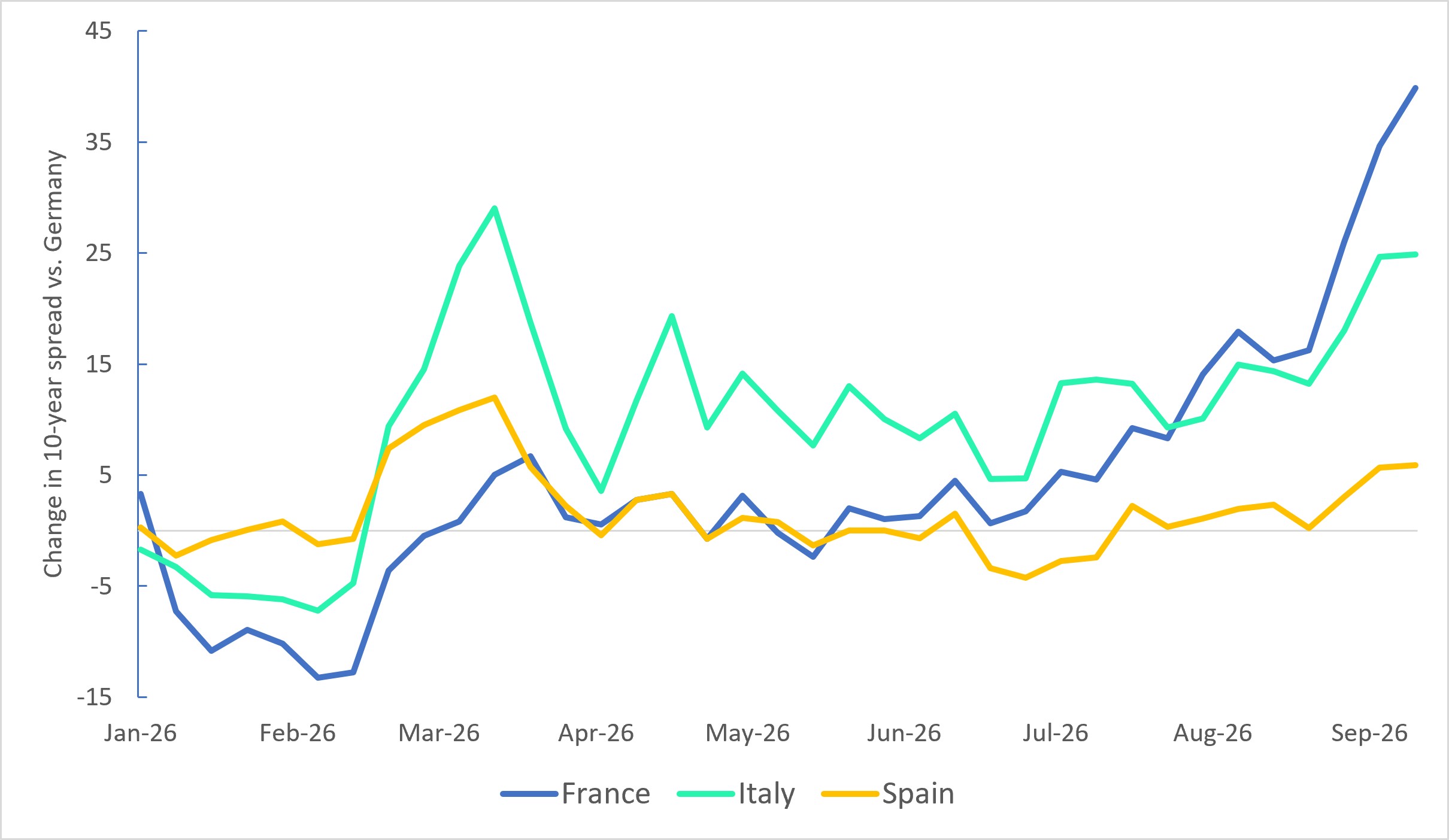
In bond markets, the week brought meaningful bifurcation in euro area government bond (EGB) spreads. The French government presented its 2027 budget proposal, which assumes a EUR 54 billion reduction in the deficit from 2026. This reduction, however, is measured against a 2027 baseline built on the same spending trend as in 2026. Compared with 2026 data, the deficit reduction would be closer to EUR 30 billion. The budget will be debated in the National Assembly and is likely to be amended. Market participants did not welcome the proposal, and the spread between French government bonds (OATs) and German Bunds widened to 141 basis points (bps) at Friday’s close.[2] Other European sovereigns were also hit during the week. The Italian government bond (BTP)-Bund spread has widened considerably since early September, as have Spanish spreads since the end of August. Yields on weaker sovereigns rose even as Bunds held firm, a clear decoupling from the German benchmark (see Chart of the Week). We note that the French spread reached its widest level since the euro area sovereign debt crisis in 2012, and the pace of widening elsewhere in the periphery was among the fastest in recent years.
US and European credit spreads widened over the week as overall market volatility increased. The acceleration in bond yields during the final week of September left most high-quality investment grade markets in negative territory on a year-to-date total return basis. High yield markets lost between two and three points over the month, but their year-to-date total returns remain positive. High yield, however, underperformed investment grade in total return terms in September. With high yield index prices five to six points below par, the convexity argument seems to be returning in force. Higher yields will, of course, hurt the weakest balance sheets, and it is no surprise to see US CCC-rated credit underperforming in this environment, with spreads above 1,200 bps. Nonetheless, we believe the strength of the macro backdrop and the earnings cycle is likely to offer compelling opportunities to add to high yield exposure. Third-quarter earnings season will start soon and should refocus investor attention on what we view as an exceptional earnings cycle.
Looking ahead, bond yields are likely to remain the key focus. Friday’s weak US employment report brought some calm to markets as the probability of an October hike by the Federal Reserve (Fed) receded. The ISM services index, which has recovered strongly over the past few months, promises to be an important data point as its employment component will be closely scrutinized following September's disappointing payrolls data. In Europe, we expect ECB officials to comment on EGB fragmentation ahead of the final September inflation data due on October 16. All eyes remain on France, where the political debate is heating up as budget discussions begin in the National Assembly.
Chart of the Week: France, Italy, Spain: Spread Moves (bps) vs. Bund Since Jan-26
Source: Bloomberg, as of October 2, 2026. Muzinich views and opinions are subject to change. For illustrative purposes only, not to be construed as investment advice or an invitation to engage in any investment activity.
References
[1] US Bureau of Labor Statistics, “The Employment Situation – September 2026,” as of October 2, 2026
[2] Bloomberg, as of October 2 2026, 10 year EUR France sovereign curve and EUR German sovereign curve
Past performance is not a reliable indicator of current or future results.
References to specific companies is for illustrative purposes only and does not reflect the holdings of any specific past or current portfolio or account.
This material is not intended to be relied upon as a forecast, research, or investment advice, and is not a recommendation, offer or solicitation to buy or sell any securities or to adopt any investment strategy. The opinions expressed by Muzinich & Co. are as of October 2, 2026, and may change without notice. All data figures are from Bloomberg, as of October 2, 2026, unless otherwise stated.
--------
Important Information
Muzinich & Co., “Muzinich” and/or the “Firm” referenced herein is defined as Muzinich & Co. Inc. and its affiliates. This material has been produced for information purposes only and as such the views contained herein are not to be taken as investment advice. Opinions are as of date of publication and are subject to change without reference or notification to you. Past performance is not a reliable indicator of current or future results and should not be the sole factor of consideration when selecting a product or strategy. The value of investments and the income from them may fall as well as rise and is not guaranteed and investors may not get back the full amount invested. Rates of exchange may cause the value of investments to rise or fall. Emerging Markets may be more risky than more developed markets for a variety of reasons, including but not limited to, increased political, social and economic instability, heightened pricing volatility and reduced market liquidity. Any research in this document has been obtained and may have been acted on by Muzinich for its own purpose. The results of such research are being made available for information purposes and no assurances are made as to their accuracy. Opinions and statements of financial market trends that are based on market conditions constitute our judgment and this judgment may prove to be wrong. The views and opinions expressed should not be construed as an offer to buy or sell or invitation to engage in any investment activity, they are for information purposes only. Any forward-looking information or statements expressed in the above may prove to be incorrect. In light of the significant uncertainties inherent in the forward-looking statements included herein, the inclusion of such information should not be regarded as a representation that the objectives and plans discussed herein will be achieved. Muzinich gives no undertaking that it shall update any of the information, data and opinions contained in the above.
United Arab Emirates (UAE): This information is provided for discussion and informational purposes only and does not constitute an offer or solicitation in the UAE. It is intended solely for Professional Investors and should not be relied upon by any other person. This material has not been reviewed or approved by the UAE Securities and Commodities Authority, the UAE Central Bank or any other relevant authority. Nothing contained herein constitutes investment, legal, tax or other professional advice. Recipients should make their own independent assessment where appropriate.
Abu Dhabi Global Market (ADGM): This information is provided for discussion and informational purposes only and does not constitute an offer or solicitation in the ADGM. It is intended solely for Professional Clients (as defined by the Financial Services Regulatory Authority) and should not be relied upon by any other person. This material has not been reviewed or approved by the Financial Services Regulatory Authority or any other relevant authority in the UAE.
United States: This material is for Institutional Investor use only – not for retail distribution. Muzinich & Co., Inc. is a registered investment adviser with the Securities and Exchange Commission (SEC). Muzinich & Co., Inc.’s being a Registered Investment Adviser with the SEC in no way shall imply a certain level of skill or training or any authorization or approval by the SEC.
Issued in the European Union by Muzinich & Co. (Ireland) Limited, which is authorized and regulated by the Central Bank of Ireland. Registered in Ireland, Company Registration No. 307511. Registered address: 32 Molesworth Street, Dublin 2, D02 Y512, Ireland. Issued in Switzerland by Muzinich & Co. (Switzerland) AG. Registered in Switzerland No. CHE-389.422.108. Registered address: Tödistrasse 5, 8002 Zurich, Switzerland. Issued in Singapore and Hong Kong by Muzinich & Co. (Singapore) Pte. Limited, which is licensed and regulated by the Monetary Authority of Singapore. Registered in Singapore No. 201624477K. Registered address: 6 Battery Road, #26-05, Singapore, 049909. Issued in all other jurisdictions (excluding the U.S.) by Muzinich & Co. Limited. which is authorized and regulated by the Financial Conduct Authority. Registered in England and Wales No. 3852444. Registered address: 8 Hanover Street, London W1S 1YQ, United Kingdom.

By clicking "Submit", I am (i) signing up to receive the Opinion Pieces from the "Opinions" page of the Muzinich & Co website, (ii) representing that the above information is true and accurate and (iii) agreeing to join the Muzinich & Co mailing list. I understand that Muzinich & Co will not add retail investors or individuals with personal email addresses to its mailing list and represent that I am not a retail investor. By providing my personal and professional information I am consenting to its use and disclosure in accordance with the Muzinich & Co. Privacy Policy. I understand that I may withdraw my consent and unsubscribe from receiving future communications by clicking "Unsubscribe" from the emails that are sent to me from Muzinich & Co.

Oct 19, 2026
Muzinich Weekly Market Comment: Occam’s Razor
China came back from Golden Week with good news on two fronts.

Oct 12, 2026
Muzinich Weekly Market Comment: Inflation, Growth, or Sustainability
It was a quiet week, at least relative to the past five, during which investor fears climbed, prompted by a wholesale reassessment of expectations for the final quarter. At the epicenter was central bank tightening, with investors pushing out their projections for the peak in rates across the globe.

Oct 08, 2026
Corporate Credit Snapshot - October 2026
September offered fixed income investors little room to hide, and global credit delivered negative returns as both short- and long-term rates moved higher.