Muzinich Weekly Market Comment: The Executive Years – Two Years, One Pen
Insight
November 9, 2026
If you have any feedback on this article or are interested in subscribing to our content, please contact us at opinions@muzinich.com or fill out the form on the right hand side of this page.
--------
It was a good week for healthcare and green energy, and for the Democrats. Less so for AI, fossil fuels and defence, and for the Republicans. One cannot look past the US midterm elections as the week’s driving force. Billed as a referendum on the cost of living, the vote delivered a broadly expected result. Since 1946 there have been 20 midterms, and the president’s party has lost House seats in 18 of them (90% of the time). The scale of those losses is closely linked to presidential approval, and with Trump at 39%, the warning signs were in plain sight. [1]
However, as the results filtered through, the picture for the administration proved worse than expected, with Democrats taking a clean sweep. As of the end of last week, they look set for 54 to 56 Senate seats, with Alaska and Mississippi still unresolved, after upsets in Texas, Kansas and South Carolina. In the House, they have flipped more than 40 seats, for a projected 251 to 268. A majority of roughly 260 would be the largest Democratic House majority since the early 1990s. Below the federal level, Democrats flipped governorships in Alaska, Georgia, Iowa, Nevada, Ohio and Texas, taking a majority of governors’ mansions for the first time since 2010.[2]
The 120th Congress is sworn in on 3rd January 2027. From that date, Democratic majorities in both chambers mean any new law requires their support, while Trump retains his veto over anything they pass. Overriding a veto takes two-thirds of both chambers, which neither side has. The base case is therefore fiscal gridlock, with little material change to tax and spending policy over the remaining two years. The more durable consequence may lie with the Senate, which alone confirms Cabinet officers, Federal Reserve (Fed) governors and federal judges, including Supreme Court justices. With Democrats holding the majority from January, the flow of Republican-leaning confirmations will effectively stop for the remainder of the administration’s term.
As for President Trump, the ego may be bruised but the pen is still his, and for the next two years that is what will matter to investors. Beyond the veto that stops Democratic legislation, he continues to control foreign policy and trade. Expect heavy use of agency rulemaking and executive orders across areas such as energy, environmental standards, bank supervision and immigration, none of which requires congressional approval, while sanctions, troop deployments and pardons sit with the president outright.
What he cannot do alone are tax laws, appropriations, entitlements, confirmations and the debt ceiling. Appropriations matter most, because they are the laws that release money from the Treasury, and without them agencies cannot spend. The timing is pointed, with a continuing resolution required by 11th December to avoid a government shutdown. Although the deadline still falls under the outgoing Republican majority, it raises the obvious question of how much they are willing to concede, knowing a Democratic majority arrives on 3rd January.
One of Trump’s first comments after the vote was that he had no immediate plans to strike Iran, and he subsequently spoke by phone with Qatar’s leader about de-escalating tensions in the Middle East. [3] Crude collapsed on the news, with Brent falling more than 15% from its monthly high above US$114 per barrel (bbl) to well below US$100. That move strips out most of the war premium, leaving perhaps US$20/bbl of elevated delivery costs on top of a fundamental supply-and-demand level we put closer to US$75.
On the sidelines, and largely overshadowed by the US election, eight central banks met last week. Four tightened, three held and only one surprised against consensus. Mexico cut by 25 basis points (bps) to 6.25%, with policymakers stressing this was a one-off adjustment rather than the start of an easing cycle, and guidance shifting its stance toward a prolonged hold.[4]
Among those that tightened, the Reserve Bank of Australia signaled rates will stay higher for longer, with further hikes on the table should energy prices or inflation expectations deteriorate. [5] The Bank of England struck a similar note, sounding notably more concerned about inflation. Its Monetary Policy Summary observed that the risks to the inflation outlook are tilted to the upside more than at the time of the July Report. Governor Bailey went further, saying that if the Middle East conflict were to persist, as appears likely, policy may have to tighten. [6] The overnight index swap (OIS) market now prices a further 70bps of tightening over the next twelve months, elevating base rates to 4.7%.[7]
US voters may have been influenced by concerns over the cost of living, but employment does not seem to be an issue. Buried beneath the midterms and the central bank meetings was a string of very strong US employment data. The September Job Openings and Labor Turnover Survey (JOLTS) report came in considerably stronger than expected, with gains reasonably broad. Job openings rose by 333,000 to 7.52m, while the quits rate jumped to 2.1% from 1.9%, suggesting workers are more confident about their prospects.[8] Separately, Challenger, Gray & Christmas reported the fewest job cuts for any October since 2023, with hiring plans picking up as companies geared up for the holiday shopping season. Meanwhile, the all-important payrolls release delivered a strong print across the board. Nonfarm payrolls rose 165k in October. That lifted the three-month moving average to 137k, comfortably above the 50k estimated as the breakeven pace for stable unemployment, which fell to 4.1%.[9]
Overall, it was a bond-friendly week, driven by falling energy prices and the prospect of a more-fiscally constrained Washington. All credit markets closed the week with positive returns, with Europe outperforming given its sensitivity to energy costs and limited AI exposure. It was much tougher for equities, especially AI-linked names, which were already in correction mode before the vote. Democratic success in the midterms, and the Texas governorship in particular, called into question the outlook for US data centre capex, alongside the prospect of tighter regulation across the sector.
However, as the dust settles, the bigger takeaway may be that the clouds of uncertainty dogging investors over the past six to eight weeks are finally clearing: elections, central banks, earnings and possibly a war. Is it too early to think about a seasonal rally? For more patient investors, it is worth noting that the S&P 500 has been higher one year after every one of the 20 midterms since 1946, by 14.7% on average, although the record is far weaker over the first three months.[10]
Chart of the Week: Blue Wave
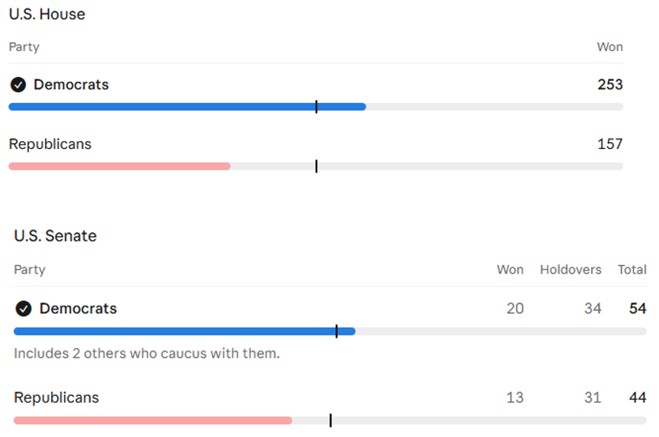
Source: Bloomberg, as of November 6, 2026. Muzinich views and opinions are subject to change. For illustrative purposes only, not to be construed as investment advice or an invitation to engage in any investment activity.
Past performance is not a reliable indicator of current or future results.
References to specific companies are for illustrative purposes only and do not reflect the holdings of any specific past or current portfolio or account.
This material is not intended to be relied upon as a forecast, research, or investment advice, and is not a recommendation, offer or solicitation to buy or sell any securities or to adopt any investment strategy. The opinions expressed by Muzinich & Co. are as of November 6, 2026, and may change without notice. All data figures are from Bloomberg, as of November 6, 2026, unless otherwise stated.
References
[1] Bloomberg, as of November 6, 2026
[2] Stateline, “Democrats win majority of governorships for the first time in 16 years,” November 4, 2026
[3] Bloomberg, “Trump Holds Call With Mediator Qatar About Iran De-Escalation,” November 6, 2026
[4] Bloomberg, “MEXICO REACT: Surprise Banxico Rate Cut Sets Up Prolonged Hold,” November 5, 2026
[5] Bloomberg, “AUSTRALIA REACT: RBA Could Hike Again as Inflation Lingers,” November 2, 2026
[6] Bloomberg, “BOE REACT: Readying a Shift to Hikes, Inflation Risks Mount,” September 17, 2026
[7] Bloomberg, as of November 6, 2026
[8] Bloomberg, “US REACT: Strong JOLTS Report Puts Focus on Nonfarm Payrolls,” November 3, 2026
[9] Bloomberg, “US REACT: Robust Payrolls, Jobless Rate Dip Revive Hike Bets,” November 6, 2026
[10]Deutsche Bank, “Early Morning Reid: Macro Strategy,” November 5, 2026
--------
Important Information
Muzinich & Co., “Muzinich” and/or the “Firm” referenced herein is defined as Muzinich & Co. Inc. and its affiliates. This material has been produced for information purposes only and as such the views contained herein are not to be taken as investment advice. Opinions are as of date of publication and are subject to change without reference or notification to you. Past performance is not a reliable indicator of current or future results and should not be the sole factor of consideration when selecting a product or strategy. The value of investments and the income from them may fall as well as rise and is not guaranteed and investors may not get back the full amount invested. Rates of exchange may cause the value of investments to rise or fall. Emerging Markets may be more risky than more developed markets for a variety of reasons, including but not limited to, increased political, social and economic instability, heightened pricing volatility and reduced market liquidity. Any research in this document has been obtained and may have been acted on by Muzinich for its own purpose. The results of such research are being made available for information purposes and no assurances are made as to their accuracy. Opinions and statements of financial market trends that are based on market conditions constitute our judgment and this judgment may prove to be wrong. The views and opinions expressed should not be construed as an offer to buy or sell or invitation to engage in any investment activity, they are for information purposes only. Any forward-looking information or statements expressed in the above may prove to be incorrect. In light of the significant uncertainties inherent in the forward-looking statements included herein, the inclusion of such information should not be regarded as a representation that the objectives and plans discussed herein will be achieved. Muzinich gives no undertaking that it shall update any of the information, data and opinions contained in the above.
United Arab Emirates (UAE): This information is provided for discussion and informational purposes only and does not constitute an offer or solicitation in the UAE. It is intended solely for Professional Investors and should not be relied upon by any other person. This material has not been reviewed or approved by the UAE Securities and Commodities Authority, the UAE Central Bank or any other relevant authority. Nothing contained herein constitutes investment, legal, tax or other professional advice. Recipients should make their own independent assessment where appropriate.
Abu Dhabi Global Market (ADGM): This information is provided for discussion and informational purposes only and does not constitute an offer or solicitation in the ADGM. It is intended solely for Professional Clients (as defined by the Financial Services Regulatory Authority) and should not be relied upon by any other person. This material has not been reviewed or approved by the Financial Services Regulatory Authority or any other relevant authority in the UAE.
United States: This material is for Institutional Investor use only – not for retail distribution. Muzinich & Co., Inc. is a registered investment adviser with the Securities and Exchange Commission (SEC). Muzinich & Co., Inc.’s being a Registered Investment Adviser with the SEC in no way shall imply a certain level of skill or training or any authorization or approval by the SEC.
Issued in the European Union by Muzinich & Co. (Ireland) Limited, which is authorized and regulated by the Central Bank of Ireland. Registered in Ireland, Company Registration No. 307511. Registered address: 32 Molesworth Street, Dublin 2, D02 Y512, Ireland. Issued in Switzerland by Muzinich & Co. (Switzerland) AG. Registered in Switzerland No. CHE-389.422.108. Registered address: Tödistrasse 5, 8002 Zurich, Switzerland. Issued in Singapore and Hong Kong by Muzinich & Co. (Singapore) Pte. Limited, which is licensed and regulated by the Monetary Authority of Singapore. Registered in Singapore No. 201624477K. Registered address: 6 Battery Road, #26-05, Singapore, 049909. Issued in all other jurisdictions (excluding the U.S.) by Muzinich & Co. Limited. which is authorized and regulated by the Financial Conduct Authority. Registered in England and Wales No. 3852444. Registered address: 8 Hanover Street, London W1S 1YQ, United Kingdom.

By clicking "Submit", I am (i) signing up to receive the Opinion Pieces from the "Opinions" page of the Muzinich & Co website, (ii) representing that the above information is true and accurate and (iii) agreeing to join the Muzinich & Co mailing list. I understand that Muzinich & Co will not add retail investors or individuals with personal email addresses to its mailing list and represent that I am not a retail investor. By providing my personal and professional information I am consenting to its use and disclosure in accordance with the Muzinich & Co. Privacy Policy. I understand that I may withdraw my consent and unsubscribe from receiving future communications by clicking "Unsubscribe" from the emails that are sent to me from Muzinich & Co.

Nov 02, 2026
Muzinich Weekly Market Comment: Something for everyone: politics, central banks and resilient growth
Last week gave every corner of the market something to digest: Lula’s surprise re-election, a hung parliament in Israel and Lagarde’s early exit from the ECB; three major central banks on hold but eyeing December hikes; and strong growth and earnings, shadowed by growing unease over the AI cycle.

Oct 19, 2026
Muzinich Weekly Market Comment: Occam’s Razor
China came back from Golden Week with good news on two fronts.

Oct 12, 2026
Muzinich Weekly Market Comment: Inflation, Growth, or Sustainability
It was a quiet week, at least relative to the past five, during which investor fears climbed, prompted by a wholesale reassessment of expectations for the final quarter. At the epicenter was central bank tightening, with investors pushing out their projections for the peak in rates across the globe.