Parallel lending: Diversification beyond traditional private credit
Insight
October 7, 2026
If you have any feedback on this article or are interested in subscribing to our content, please contact us at opinions@muzinich.com or fill out the form on the right hand side of this page.
--------
Parallel lending can provide a differentiated source of diversification, offering access to bank-originated European corporate loans with floating-rate income, senior-secured structures and exposure beyond traditional public and private credit markets.
Diversification is a cornerstone of portfolio construction. But meaningful diversification is about more than simply owning more investments; it means accessing different sources of risk and return.
We believe parallel lending can add another dimension to a diversified credit allocation. Sitting at the intersection of bank lending and private credit, it provides access to a broad universe of European corporate borrowers, alongside the potential for attractive floating-rate income, portfolio granularity and strong structural protections.
Diversifying credit exposure
Public credit can provide considerable security-level diversification, but valuations remain influenced by movements in government bond yields, credit spreads and investor sentiment.
Private credit offers a different source of exposure, although much of the market has traditionally centred on direct lending, often involving private-equity-sponsored borrowers.
Parallel lending offers another route. Rather than replacing banks, an asset manager lends alongside them, providing capital to established European small and medium-sized enterprises (SMEs). The bank remains closely involved with the borrower, while the asset manager typically participates on a senior-secured, first-lien, pari passu basis.
For investors, this provides access to a segment of corporate lending that can be difficult to reach through public bonds or traditional sponsor-backed private credit.
"Parallel lending can introduce different borrowers, different return drivers and different risk exposures."
A BROADER BORROWER UNIVERSE
Europe has a deep and diverse universe of SMEs, many with longstanding banking relationships. These businesses span industries and end markets, with financing needs ranging from investment and acquisitions to refinancing and general corporate purposes.
Many are domestically focused, giving them different revenue drivers from the large multinationals that dominate global bond indices. Family-owned and independently managed companies can also have different characteristics from the larger, often sponsor-backed borrowers commonly found in direct lending portfolios.
Accessing these businesses through established banking networks can therefore broaden an investor’s opportunity set and diversify exposure beyond more familiar sources of corporate credit.
Figure 1 – Eligible European corporate loan universe vs. high yield, syndicated loan and private debt markets
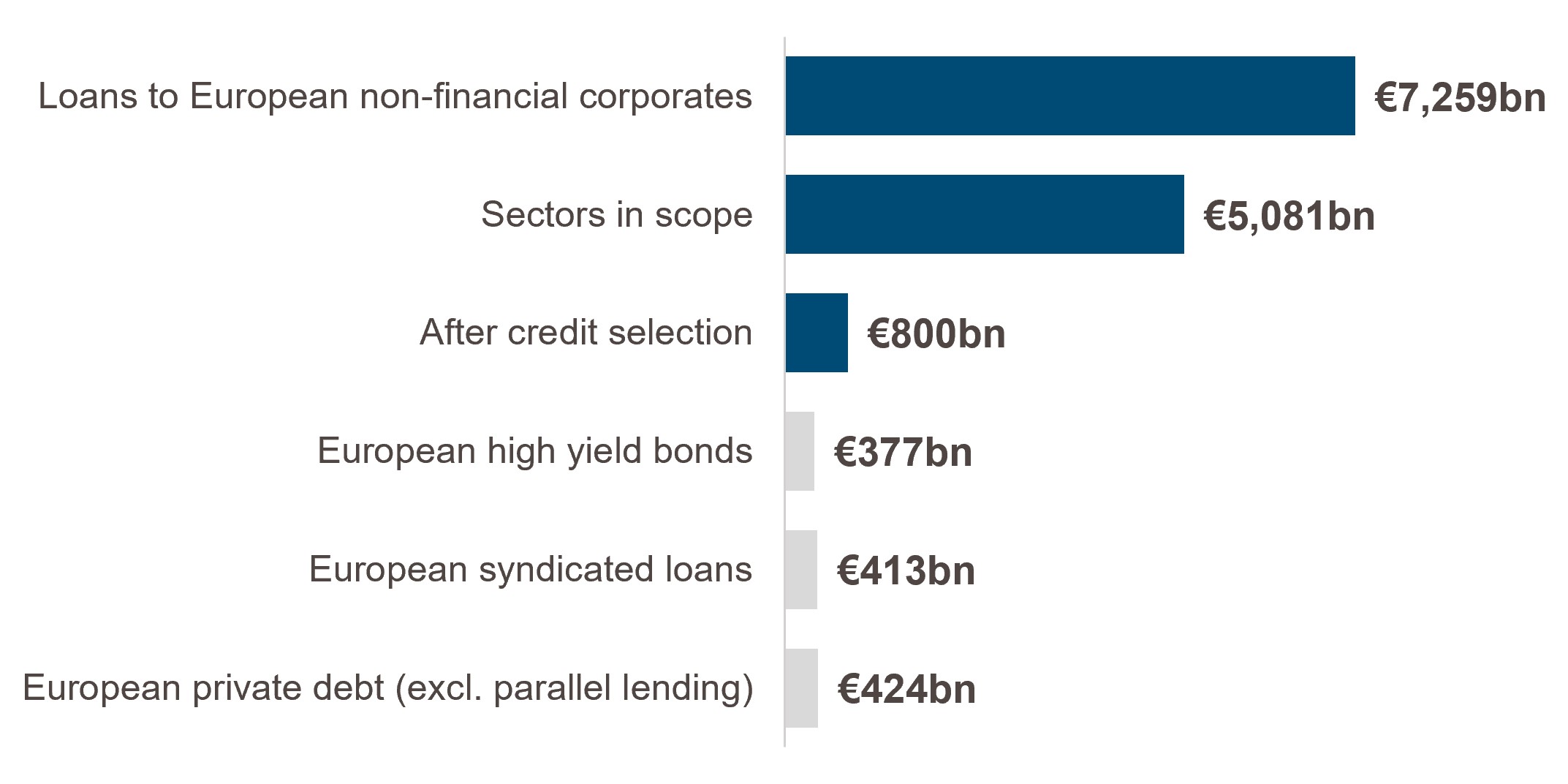
Source: Muzinich analysis using data from the ECB Statistical Data Warehouse and the Bank for International Settlements (Q1 2025 data, published September 2025), ICE BofA European High Yield Constrained Index (August 2025), Institutional Western European Leverage Loan Index, S&P UBS WELLI (August 2025) and Preqin (September 2024). Sectors in scope exclude financial and real estate/construction sectors and the strategy’s ESG-excluded sectors. Credit selection is based on the rejection rate of the Muzinich Parallel Lending Credit Strategy (Q1 2025). European private debt excludes parallel lending. For illustrative purposes only.
Eligible loans of €5,081bn are more than four times the high yield, syndicated loan and private debt markets combined (€1,214bn).
DIVERSIFICATION WITHIN THE PORTFOLIO
Diversification is equally important within the strategy itself. In private markets, concentrated portfolios can leave investors particularly exposed to individual credit events.
A parallel lending portfolio holding more than 100 individual loans at any one time can provide significant diversification and granularity, spreading exposure across borrowers, sectors and geographies.
Keeping individual positions relatively small can also help limit the impact of a default by any single issuer on the broader portfolio. Diversification cannot eliminate credit or default risk, but greater granularity can reduce dependence on individual borrowers and mitigate the portfolio-level impact of individual credit events.
This can create a different risk profile from private credit strategies concentrated in a relatively small number of larger loans.

DIVERSIFYING INTEREST-RATE EXPOSURE
Parallel lending also diversifies how returns are generated.
Loans are typically floating rate, with coupons comprising a reference rate plus a contractual credit spread. Income can therefore adjust as short-term interest rates change.
This contrasts with fixed-rate bonds, whose valuations can be significantly affected by movements in government bond yields. Floating-rate private credit has limited interest-rate duration and can therefore complement traditional fixed-rate allocations.
Higher rates can, however, increase borrowers’ financing costs and place pressure on cashflows. This reinforces the importance of conservative leverage, careful borrower selection and ongoing monitoring. Floating-rate private credit has limited interest-rate duration and can therefore complement traditional fixed-rate allocations.
A FOCUS ON DOWNSIDE PROTECTION
Parallel loans can also benefit from protections traditionally associated with senior bank financing. Investments are generally senior secured and first lien, with the parallel lender ranking pari passu with the originating bank. Covenants can provide additional protections, while the bank may bring longstanding relationships and detailed knowledge of the borrower.
The effectiveness of this approach can also be considered in the context of realised credit losses. Expected loss in the parallel lending market is around 20 basis points, while our track record has experienced actual losses of approximately 2 basis points.
While historical loss experience is not a guide to future outcomes, we believe the comparison highlights the potential benefits of disciplined credit selection, diversification and active portfolio monitoring. With exposure spread across more than 100 loans, the impact of an individual credit event can potentially be contained, while seniority, security and covenant protections provide additional layers of downside mitigation.
These features cannot eliminate credit risk or guarantee against losses. However, taken together, they can contribute to a disciplined approach to managing downside risk.
COMPLEMENTARY, RATHER THAN COMPETING
The case for parallel lending is not that it should replace public credit or traditional direct lending. Its value lies in being different.
For private credit investors, it can broaden exposure beyond sponsor-backed transactions and introduce a more granular universe of borrowers. For investors with significant public fixed-income allocations, floating-rate loans can provide another source of income with limited sensitivity to government bond yields.
It can also diversify the way credit risk itself is accessed. Rather than concentrating capital in a relatively small number of transactions, investors can gain exposure to a broad pool of predominantly domestically focused European businesses through established bank-originated lending relationships.
At a time when investors are increasingly asking not simply how much private credit they own, but what kind, that distinction matters.
By providing access to a broad and granular universe of bank-originated European corporate loans, parallel lending can introduce different borrowers, different return drivers and different risk exposures. Combined with floating-rate income, senior-secured structures and a highly diversified portfolio, we believe it can provide a genuinely complementary source of diversification within a broader credit allocation.
This material is not intended to be relied upon as a forecast, research, or investment advice, and is not a recommendation, offer or solicitation to buy or sell any securities or to adopt any investment strategy. The opinions expressed by Muzinich & Co are as of September 2026 and may change without notice.
--------
Important information
Muzinich and/or Muzinich & Co. referenced herein is defined as Muzinich & Co., Inc. and its affiliates. Muzinich views and opinions. This material has been produced for information purposes only and as such the views contained herein are not to be taken as investment advice. Opinions are as of date of publication and are subject to change without reference or notification to you. Past performance is not a reliable indicator of current or future results and should not be the sole factor of consideration when selecting a product or strategy. The value of investments and the income from them may fall as well as rise and is not guaranteed and investors may not get back the full amount invested. Rates of exchange may cause the value of investments to rise or fall.
Any research in this document has been obtained and may have been acted on by Muzinich for its own purpose. The results of such research are being made available for information purposes and no assurances are made as to their accuracy. Opinions and statements of financial market trends that are based on market conditions constitute our judgment and this judgment may prove to be wrong. The views and opinions expressed should not be construed as an offer to buy or sell or invitation to engage in any investment activity, they are for information purposes only.
This discussion material contains forward-looking statements, which give current expectations of future activities and future performance. Any or all forward-looking statements in this material may turn out to be incorrect. They can be affected by inaccurate assumptions or by known or unknown risks and uncertainties. Although the assumptions underlying the forward-looking statements contained herein are believed to be reasonable, any of the assumptions could be inaccurate and, therefore, there can be no assurances that the forward-looking statements included in this discussion material will prove to be accurate. In light of the significant uncertainties inherent in the forward-looking statements included herein, the inclusion of such information should not be regarded as a representation that the objectives and plans discussed herein will be achieved. Further, no person undertakes any obligation to revise such forward-looking statements to reflect events or circumstances after the date hereof or to reflect the occurrence of unanticipated events.
Issued in the European Union by Muzinich & Co. (Ireland) Limited, which is authorized and regulated by the Central Bank of Ireland. Registered in Ireland, Company Registration No. 307511. Registered address: 32 Molesworth Street, Dublin 2, D02 Y512, Ireland. Issued in Switzerland by Muzinich & Co. (Switzerland) AG. Registered in Switzerland No. CHE-389.422.108. Registered address: Tödistrasse 5, 8002 Zurich, Switzerland. Issued in Singapore and Hong Kong by Muzinich & Co. (Singapore) Pte. Limited, which is licensed and regulated by the Monetary Authority of Singapore. Registered in Singapore No. 201624477K. Registered address: 6 Battery Road, #26-05, Singapore, 049909. Issued in all other jurisdictions (excluding the U.S.) by Muzinich & Co. Limited. which is authorized and regulated by the Financial Conduct Authority. Registered in England and Wales No. 3852444. Registered address: 8 Hanover Street, London W1S 1YQ, United Kingdom. 2026-10-01-19539


By clicking "Submit", I am (i) signing up to receive the Opinion Pieces from the "Opinions" page of the Muzinich & Co website, (ii) representing that the above information is true and accurate and (iii) agreeing to join the Muzinich & Co mailing list. I understand that Muzinich & Co will not add retail investors or individuals with personal email addresses to its mailing list and represent that I am not a retail investor. By providing my personal and professional information I am consenting to its use and disclosure in accordance with the Muzinich & Co. Privacy Policy. I understand that I may withdraw my consent and unsubscribe from receiving future communications by clicking "Unsubscribe" from the emails that are sent to me from Muzinich & Co.

Oct 19, 2026
Stronger Together: The Power of Parallel Lending
In our latest podcast, Grant Davidson, Co-Head of Private Debt, UK, and James Adams, Director in our UK Private Debt team, explore the growing role of parallel lending in European private credit.

Oct 14, 2026
Parallel lending: Five lessons learned
Gianluca Oricchio and Gianpaolo Pellegrini share five lessons from investing alongside Europe’s banks, covering bank partnerships, credit selection, portfolio construction and liquidity, and consider how the opportunity could evolve from here.

Jun 04, 2026
The evolution of private credit: Understanding direct and parallel lending
Private credit is no longer one-size-fits-all. Understanding different lending models can help investors evaluate opportunities and balance risk and return, say Kirsten Bode and Gianpaolo Pellegrini.