Parallel lending: Five lessons learned
Insight
October 14, 2026
If you have any feedback on this article or are interested in subscribing to our content, please contact us at opinions@muzinich.com or fill out the form on the right hand side of this page.
--------
Private credit investing has changed considerably over the recent past. Higher interest rates have raised borrowing costs, competition has intensified in parts of the market, and concerns around leverage, liquidity and credit quality have put greater emphasis on understanding the risks investors take to generate returns.
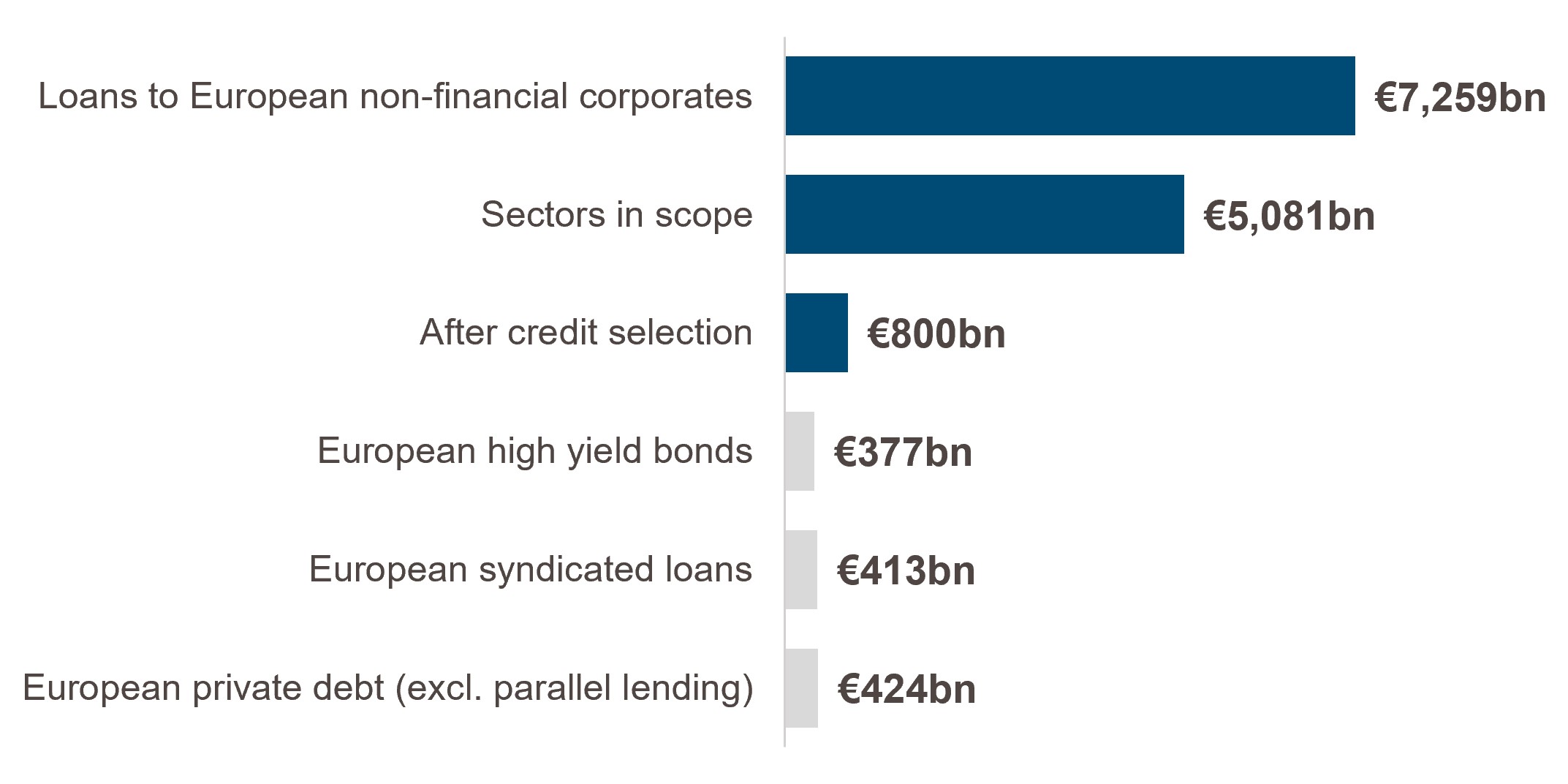
Against this backdrop, investing alongside European banks has reinforced three of our original assumptions about parallel lending (Figure 1). These principles shape how we approach the asset class and underpin five lessons we have learned.
Figure 1: Three principles behind our parallel-lending approach
1. Bank partnerships strengthen origination capabilities
One of the clearest lessons has been the value of bank relationships as a source of investment opportunities.
Europe remains a predominantly bank-financed corporate market. Banks have longstanding relationships with companies and extensive origination networks built over many years. Investing alongside them can therefore provide access to a broad pool of upper- and middle-market corporate borrowers that may be less accessible through traditional private credit channels.
But the benefit is not simply the number of transactions banks can originate. It is the choice that a large and recurring pipeline provides.
Across our parallel-lending platform, we have screened approximately 1,400 opportunities across multiple European markets and banks have accounted for around two-thirds of this origination.
For us, the lesson is that the strength of an origination network should not be measured simply by how much capital it allows a manager to deploy. Its real value lies in providing a sufficiently broad opportunity set from which to construct a portfolio selectively.
2. Access only becomes an advantage when combined with selectivity
Our second lesson follows directly from the first: seeing more deals should not mean doing more deals. Around 85% of the opportunities screened on our platform have been rejected.
That matters in an asset class where large amounts of capital have been raised and managers can face pressure to put it to work. We believe a large pipeline should do the opposite: it should give an investment team the freedom to walk away when leverage, cash-flow generation, documentation, structure or pricing do not compensate for the underlying risk.
Independent underwriting is therefore central to the model. Investing alongside a regulated bank provides alignment with the originating lender, but it does not replace the need to form our own view of each borrower. The combination of bank-partnered origination and disciplined selection has become one of the defining characteristics of our approach.
Figure 2: A broad pipeline, selectively deployed
Opportunities screened across our parallel-lending platform

Source: Fig. 2. Muzinich & Co, as of 31st August 2026. For illustrative purposes only. * Other third from sponsors and advisers
3. Look at the risk supporting the income, not just the income
It’s also important to look beyond headline private-credit yields.
Higher underlying reference rates can increase the income available from floating-rate loans. But those same higher rates increase borrowers’ interest costs. Assessing the sustainability of that income therefore requires an understanding of the leverage and debt-servicing capacity of the companies behind it.
This is why we deliberately target relatively low-levered businesses, primarily through senior-secured loans. Lower leverage can provide borrowers with greater capacity to absorb higher interest costs and can provide lenders with an additional cushion if operating conditions deteriorate. Within our evergreen parallel lending strategy, average borrower leverage has been around 3.5x EBITDA and the ratio EBITDA on Cost of Debt is north of 4x, with exposure diversified across more than 160 companies.
We believe the combination of seniority, conservative leverage and portfolio granularity can provide an important source of resilience.
Granularity is particularly relevant in private credit, where problems at individual borrowers can have a disproportionate impact on concentrated portfolios. Diversification cannot eliminate the possibility of losses, but spreading exposure across many companies, sectors and geographies can help reduce reliance on the performance of any single borrower.
The lesson is therefore not simply to seek attractive income. It is to ask how much credit and concentration risk is being taken to generate it.
Figure 3: Conservative leverage, broad diversification and natural liquidity
Evergreen parallel-lending strategy, portfolio characteristics
 Source: Fig. 3. Muzinich & Co., evergreen parallel-lending strategy, as of 31st August 2026 Average leverage and EBITDA cover are portfolio averages GAV: gross asset value. For illustrative purposes only.
4. A private credit portfolio can generate natural liquidity
Matching the illiquidity of private assets with periodic investor redemption windows is one of the central challenges of an evergreen structure.
One approach is to maintain a significant allocation to liquid public securities that can be sold to meet redemption requirements. Our experience with parallel lending has however highlighted another potential source of liquidity: the private loans themselves.
Many parallel-lending transactions include scheduled term-loan amortisation, while borrowers may also repay loans early as they refinance, sell businesses or otherwise reduce debt.
Within our evergreen parallel lending strategy, amortisation and prepayments have generated natural liquidity equivalent to approximately 15–20% of GAV annually. This does not make private loans liquid securities or eliminate the need to manage liquidity carefully. But it can reduce reliance on selling public-market assets by generating cash naturally from within the private portfolio.
That distinction becomes particularly important during periods of market stress, when selling assets may mean accepting unattractive prices. For us, liquidity is therefore not simply a feature of the strategy's structure. It begins with the characteristics of the underlying loans and is considered from the outset of portfolio construction, helping reduce reliance on asset sales when markets are under pressure.
Bank and private capital are becoming increasingly complementary
Perhaps the most significant lesson is that the relationship between banks and private credit is more complementary than is sometimes assumed.
The expansion of private credit is frequently presented as a story of non-bank lenders taking market share from banks. Our experience suggests the distinction is becoming less binary.
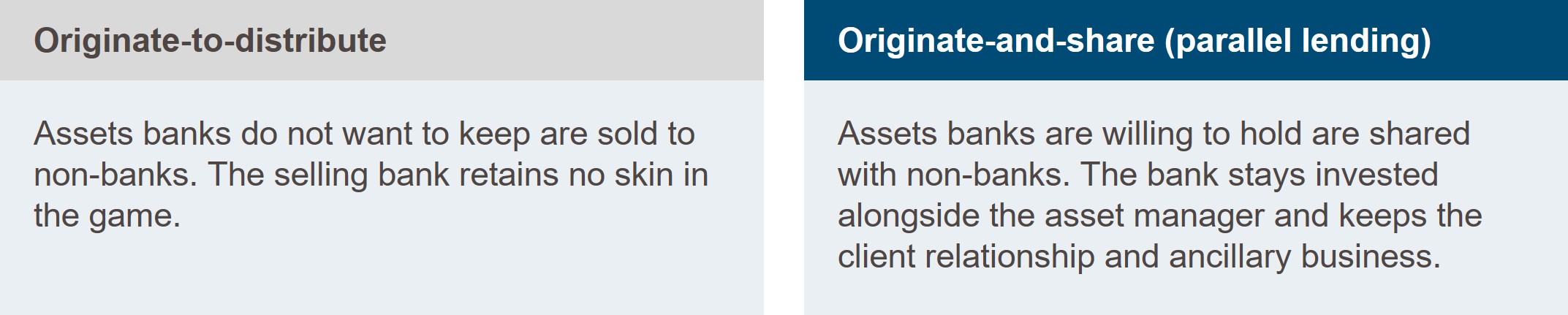
Banks want to maintain valuable corporate relationships with low levered companies and the ancillary business associated with them. At the same time, regulatory capital requirements mean they need to consider carefully how much credit exposure they retain on their balance sheets. Bank assets that are not palatable for banks are sold to non-banks (via the originate-to-distribute business model), meaning no more skin-in-the-game of the seller bank; while bank assets that are palatable can be shared with non-banks (via the originate-and-share business model), meaning that there is still skin-in-the-game by the sharing bank.
Figure 4: Two ways banks share credit exposure with non-bank lenders
Source: Fig. 4. Source: Muzinich & Co. views and opinions, for illustrative purposes only.
Parallel lending can facilitate the originate-and-share business model, bring risk sharing and preservation of the ancillary business together. Banks can originate financing and remain invested alongside an asset manager, while sharing a portion of the exposure with institutional capital.
For investors, we believe this creates access to a sizeable pool of European corporate lending opportunities. Our analysis indicates the universe of European corporate credit potentially suitable for parallel lending is significantly larger than the European direct lending market.
This suggests the opportunity is not simply the product of a particular point in the credit cycle. It reflects a broader evolution in the way European corporate lending can be financed.
5. What have three years taught us?
Three years of managing an evergreen parallel-lending strategy have made our view of the opportunity more nuanced. Bank partnerships can broaden the opportunity set, but access needs to be matched by selectivity. Attractive income needs to be supported by conservative leverage, seniority and diversification. And in an evergreen strategy, liquidity can come not only from selling assets, but from cash generated naturally by the underlying portfolio.
Taken together, these lessons reinforce our belief that the next phase of private credit need not be defined by competition between banks and asset managers. Parallel lending can bring together banks’ origination capabilities and corporate relationships with an asset manager’s independent credit selection, institutional capital and disciplined portfolio construction.
We believe it is this combination that makes parallel lending a differentiated part of the private-credit opportunity and contributes to increasing the share of real economy financing in the system.
This material is not intended to be relied upon as a forecast, research, or investment advice, and is not a recommendation, offer or solicitation to buy or sell any securities or to adopt any investment strategy. The opinions expressed by Muzinich & Co. are as of October 2026 and may change without notice.
--------
Important information
Muzinich and/or Muzinich & Co. referenced herein is defined as Muzinich & Co., Inc. and its affiliates. Muzinich views and opinions. This material has been produced for information purposes only and as such the views contained herein are not to be taken as investment advice. Opinions are as of date of publication and are subject to change without reference or notification to you. Past performance is not a reliable indicator of current or future results and should not be the sole factor of consideration when selecting a product or strategy. The value of investments and the income from them may fall as well as rise and is not guaranteed and investors may not get back the full amount invested. Rates of exchange may cause the value of investments to rise or fall.
Any research in this document has been obtained and may have been acted on by Muzinich for its own purpose. The results of such research are being made available for information purposes and no assurances are made as to their accuracy. Opinions and statements of financial market trends that are based on market conditions constitute our judgment and this judgment may prove to be wrong. The views and opinions expressed should not be construed as an offer to buy or sell or invitation to engage in any investment activity, they are for information purposes only.
This discussion material contains forward-looking statements, which give current expectations of future activities and future performance. Any or all forward-looking statements in this material may turn out to be incorrect. They can be affected by inaccurate assumptions or by known or unknown risks and uncertainties. Although the assumptions underlying the forward-looking statements contained herein are believed to be reasonable, any of the assumptions could be inaccurate and, therefore, there can be no assurances that the forward-looking statements included in this discussion material will prove to be accurate. In light of the significant uncertainties inherent in the forward-looking statements included herein, the inclusion of such information should not be regarded as a representation that the objectives and plans discussed herein will be achieved. Further, no person undertakes any obligation to revise such forward-looking statements to reflect events or circumstances after the date hereof or to reflect the occurrence of unanticipated events.
United Arab Emirates (UAE): This information is provided for discussion and informational purposes only and does not constitute an offer or solicitation in the UAE. It is intended solely for Professional Investors and should not be relied upon by any other person. This material has not been reviewed or approved by the UAE Securities and Commodities Authority, the UAE Central Bank or any other relevant authority. Nothing contained herein constitutes investment, legal, tax or other professional advice. Recipients should make their own independent assessment where appropriate.
Abu Dhabi Global Market (ADGM): This information is provided for discussion and informational purposes only and does not constitute an offer or solicitation in the ADGM. It is intended solely for Professional Clients (as defined by the Financial Services Regulatory Authority) and should not be relied upon by any other person. This material has not been reviewed or approved by the Financial Services Regulatory Authority or any other relevant authority in the UAE.
United States: This material is for Institutional Investor use only – not for retail distribution. Muzinich & Co., Inc. is a registered investment adviser with the Securities and Exchange Commission (SEC). Muzinich & Co., Inc.’s being a Registered Investment Adviser with the SEC in no way shall imply a certain level of skill or training or any authorization or approval by the SEC.
Issued in the European Union by Muzinich & Co. (Ireland) Limited, which is authorized and regulated by the Central Bank of Ireland. Registered in Ireland, Company Registration No. 307511. Registered address: 32 Molesworth Street, Dublin 2, D02 Y512, Ireland. Issued in Switzerland by Muzinich & Co. (Switzerland) AG. Registered in Switzerland No. CHE-389.422.108. Registered address: Tödistrasse 5, 8002 Zurich, Switzerland. Issued in Singapore and Hong Kong by Muzinich & Co. (Singapore) Pte. Limited, which is licensed and regulated by the Monetary Authority of Singapore. Registered in Singapore No. 201624477K. Registered address: 6 Battery Road, #26-05, Singapore, 049909. Issued in all other jurisdictions (excluding the U.S.) by Muzinich & Co. Limited. which is authorized and regulated by the Financial Conduct Authority. Registered in England and Wales No. 3852444. Registered address: 8 Hanover Street, London W1S 1YQ, United Kingdom. 2026-10-08-19592


By clicking "Submit", I am (i) signing up to receive the Opinion Pieces from the "Opinions" page of the Muzinich & Co website, (ii) representing that the above information is true and accurate and (iii) agreeing to join the Muzinich & Co mailing list. I understand that Muzinich & Co will not add retail investors or individuals with personal email addresses to its mailing list and represent that I am not a retail investor. By providing my personal and professional information I am consenting to its use and disclosure in accordance with the Muzinich & Co. Privacy Policy. I understand that I may withdraw my consent and unsubscribe from receiving future communications by clicking "Unsubscribe" from the emails that are sent to me from Muzinich & Co.

Oct 07, 2026
Parallel lending: Diversification beyond traditional private credit
Parallel lending can provide a differentiated source of diversification, offering access to bank-originated European corporate loans with floating-rate income, senior-secured structures and exposure beyond traditional public and private credit markets.

Jun 04, 2026
The evolution of private credit: Understanding direct and parallel lending
Private credit is no longer one-size-fits-all. Understanding different lending models can help investors evaluate opportunities and balance risk and return, say Kirsten Bode and Gianpaolo Pellegrini.

Feb 24, 2026
Parallel Lending Explained: Accessing European Private Credit Alongside Banks
Private credit continues to evolve, with banks and asset managers increasingly working together to finance the European middle market. In the latest episode of the Muzinich Podcast, we discuss how investing alongside banks can provide differentiated access to senior secured lending opportunities.