From accumulation to income: parallel lending as part of a DC decumulation solution
Insight
November 5, 2026
If you have any feedback on this article or are interested in subscribing to our content, please contact us at opinions@muzinich.com or fill out the form on the right hand side of this page.
--------
The UK defined contribution (DC) pension market is entering a period of significant change. As part of a broader programme of reform, greater attention is being paid to decumulation and how schemes can support members as their needs shift from accumulating savings to generating an income in retirement. Guided Retirement will require schemes to provide default retirement income solutions for members who do not make an active choice.
At the same time, there is a growing focus on broadening DC schemes’ access to private markets, with the Pension Schemes Act 2026 creating a framework that will likely require a proportion of assets in main default funds to be allocated to private assets.
Together, these developments raise an interesting investment question: as private markets become a more established part of DC portfolios and glidepaths, could some of these assets also help meet the changing needs of members as they move from accumulation to decumulation?
The investment challenge changes in decumulation
Moving from accumulation to decumulation changes what is required from the portfolio. Once members begin drawing an income, the portfolio must support regular withdrawals while seeking to preserve capital over an uncertain time horizon.
The sequence of investment returns also becomes more important. If assets need to be sold following a market decline to fund withdrawals, losses may be crystallised, leaving less capital to participate in a subsequent recovery.
This places greater emphasis on the source and consistency of investment income. Assets that generate recurring cash flows may help meet withdrawals without relying solely on selling investments.
Not all private credit is created equal
Against this backdrop, private credit could have a role to play. However, it encompasses a broad range of approaches, from senior-secured corporate lending to more leveraged strategies where a meaningful proportion of interest may be payment-in-kind (PIK), meaning reported income may accrue to the loan balance rather than being received as cash, while increasing the borrower’s outstanding debt. PIK interest may contribute to total return, but it is added to the outstanding loan rather than paid in cash and therefore cannot directly support regular withdrawals — an important distinction in decumulation, where portfolios need to generate income to help meet those withdrawals. More concentrated or highly leveraged strategies may also expose investors to greater potential capital losses at a point when preserving capital while funding withdrawals becomes increasingly important.
For an allocation intended to support retirement income, this places greater emphasis on recurring cash generation, capital preservation and diversification. These are characteristics we believe can be found in parallel lending.
Parallel lending as part of a decumulation solution
In parallel lending, an asset manager lends alongside a bank, with both retaining exposure to the borrower on pari passu terms — meaning they rank equally, with the same documentation and security.
This provides access to a different origination channel from conventional sponsor-led direct lending, with exposure to established middle-market businesses sourced through banks’ longstanding corporate relationships.
The key characteristics of a parallel lending strategy could be particularly relevant for decumulation.
1. Cash-pay income
First, the income is cash-pay. Borrowers make contractual interest payments, creating recurring portfolio cash flows. For a retirement portfolio, this potentially provides a source of income that can contribute towards withdrawals rather than requiring every payment to be financed through asset sales.
2. Senior secured
Second, the loans are generally senior secured. A focus on first-lien loans, conservative leverage and strong interest coverage can help mitigate downside risk. This does not remove credit risk, but seniority and security can help mitigate the risk of permanent capital loss.
3. Diversification
Third, diversification can be significant. A portfolio of more than 100 loans means exposure is spread across many borrowers, sectors and European markets. This reduces dependence on the performance of individual companies.
4. Floating rate
Fourth, the loans are typically floating rate. Coupons reset as the underlying reference rate changes, resulting in a low duration profile. This can provide a source of income with lower sensitivity to changes in interest rates.
5. Shorter lives and amortisation
Finally, the loans typically have shorter average lives, and a strategy can also invest in amortising tranches. As these loans repay principal progressively over their life, they can provide greater predictability around capital repayments while naturally generating liquidity within the portfolio.
These combined characteristics could make parallel lending particularly well suited to a role within a decumulation portfolio.
Liquidity remains critical
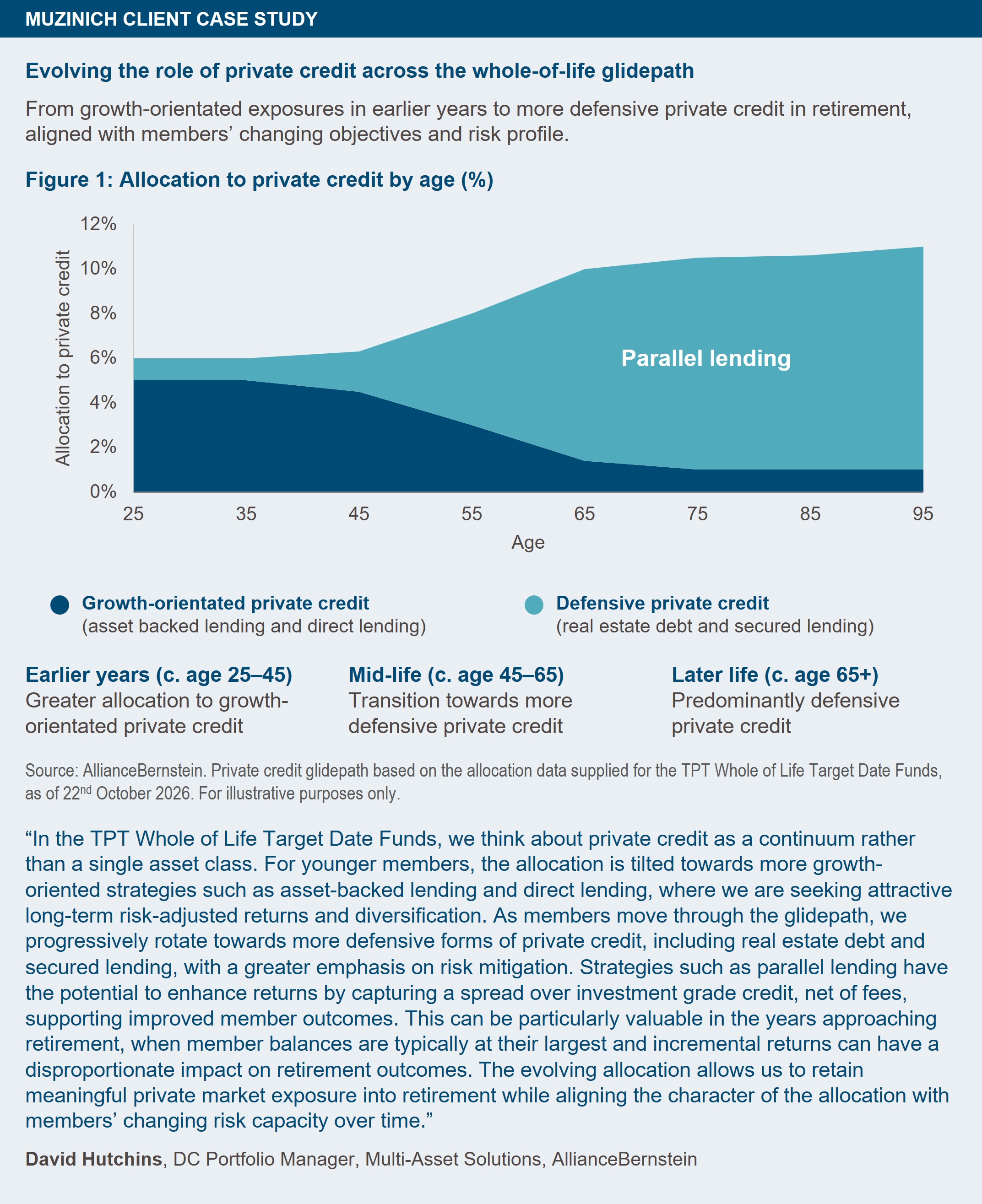
There is an obvious tension between private credit and retirement portfolios: the underlying loans are illiquid, while a decumulation portfolio needs sufficient liquidity to meet member withdrawals. Parallel lending should therefore be considered not as a standalone decumulation solution, but as one component within a broader portfolio or glidepath, as illustrated in our case study.
A retirement default solution could combine highly liquid assets to meet near-term payments and unexpected withdrawals, growth assets to help preserve the purchasing power of savings over a potentially long retirement, and income-generating assets that contribute recurring cash flows. Parallel lending could potentially play a role within this income-generating allocation, with contractual cash coupons contributing to the cash flows available to support withdrawals.
Liquidity therefore needs to be managed across the whole portfolio, rather than requiring every underlying investment to offer the same level of liquidity.
From allocation targets to retirement outcomes
The debate around private markets in DC has understandably concentrated on access and allocation levels. The next phase, we argue, should focus on outcomes.
For an asset intended to play a role in decumulation, schemes also need to consider how returns are generated, how much is delivered as cash income, how dependable those cash flows are, what happens when markets fall and how the asset interacts with the liquidity requirements of the wider portfolio.
This is where we believe parallel lending deserves consideration.
It will not solve every challenge associated with delivering sustainable retirement income, and it should not replace the liquid assets needed to meet members’ immediate requirements. But we believe senior-secured, floating-rate corporate loans that generate recurring cash income could provide a useful building block within a diversified decumulation portfolio.
As DC evolves from accumulating retirement savings towards supporting members in generating an income in retirement, schemes will need to consider not only how much to allocate to private markets, but also the role those assets can play in delivering retirement outcomes.
This material is not intended to be relied upon as a forecast, research, or investment advice, and is not a recommendation, offer or solicitation to buy or sell any securities or to adopt any investment strategy. The opinions expressed by Muzinich & Co. are as of October 2026 and may change without notice.
--------
Important information
Muzinich and/or Muzinich & Co. referenced herein is defined as Muzinich & Co., Inc. and its affiliates. Muzinich views and opinions. This material has been produced for information purposes only and as such the views contained herein are not to be taken as investment advice. Opinions are as of date of publication and are subject to change without reference or notification to you. Past performance is not a reliable indicator of current or future results and should not be the sole factor of consideration when selecting a product or strategy. The value of investments and the income from them may fall as well as rise and is not guaranteed and investors may not get back the full amount invested. Rates of exchange may cause the value of investments to rise or fall.
Any research in this document has been obtained and may have been acted on by Muzinich for its own purpose. The results of such research are being made available for information purposes and no assurances are made as to their accuracy. Opinions and statements of financial market trends that are based on market conditions constitute our judgment and this judgment may prove to be wrong. The views and opinions expressed should not be construed as an offer to buy or sell or invitation to engage in any investment activity, they are for information purposes only.
This discussion material contains forward-looking statements, which give current expectations of future activities and future performance. Any or all forward-looking statements in this material may turn out to be incorrect. They can be affected by inaccurate assumptions or by known or unknown risks and uncertainties. Although the assumptions underlying the forward-looking statements contained herein are believed to be reasonable, any of the assumptions could be inaccurate and, therefore, there can be no assurances that the forward-looking statements included in this discussion material will prove to be accurate. In light of the significant uncertainties inherent in the forward-looking statements included herein, the inclusion of such information should not be regarded as a representation that the objectives and plans discussed herein will be achieved. Further, no person undertakes any obligation to revise such forward-looking statements to reflect events or circumstances after the date hereof or to reflect the occurrence of unanticipated events.
United Arab Emirates (UAE): This information is provided for discussion and informational purposes only and does not constitute an offer or solicitation in the UAE. It is intended solely for Professional Investors and should not be relied upon by any other person. This material has not been reviewed or approved by the UAE Securities and Commodities Authority, the UAE Central Bank or any other relevant authority. Nothing contained herein constitutes investment, legal, tax or other professional advice. Recipients should make their own independent assessment where appropriate.
Abu Dhabi Global Market (ADGM): This information is provided for discussion and informational purposes only and does not constitute an offer or solicitation in the ADGM. It is intended solely for Professional Clients (as defined by the Financial Services Regulatory Authority) and should not be relied upon by any other person. This material has not been reviewed or approved by the Financial Services Regulatory Authority or any other relevant authority in the UAE.
United States: This material is for Institutional Investor use only – not for retail distribution. Muzinich & Co., Inc. is a registered investment adviser with the Securities and Exchange Commission (SEC). Muzinich & Co., Inc.’s being a Registered Investment Adviser with the SEC in no way shall imply a certain level of skill or training or any authorization or approval by the SEC.
Issued in the European Union by Muzinich & Co. (Ireland) Limited, which is authorized and regulated by the Central Bank of Ireland. Registered in Ireland, Company Registration No. 307511. Registered address: 32 Molesworth Street, Dublin 2, D02 Y512, Ireland. Issued in Switzerland by Muzinich & Co. (Switzerland) AG. Registered in Switzerland No. CHE-389.422.108. Registered address: Tödistrasse 5, 8002 Zurich, Switzerland. Issued in Singapore and Hong Kong by Muzinich & Co. (Singapore) Pte. Limited, which is licensed and regulated by the Monetary Authority of Singapore. Registered in Singapore No. 201624477K. Registered address: 6 Battery Road, #26-05, Singapore, 049909. Issued in all other jurisdictions (excluding the U.S.) by Muzinich & Co. Limited. which is authorized and regulated by the Financial Conduct Authority. Registered in England and Wales No. 3852444. Registered address: 8 Hanover Street, London W1S 1YQ, United Kingdom. 2026-10-26-19731


By clicking "Submit", I am (i) signing up to receive the Opinion Pieces from the "Opinions" page of the Muzinich & Co website, (ii) representing that the above information is true and accurate and (iii) agreeing to join the Muzinich & Co mailing list. I understand that Muzinich & Co will not add retail investors or individuals with personal email addresses to its mailing list and represent that I am not a retail investor. By providing my personal and professional information I am consenting to its use and disclosure in accordance with the Muzinich & Co. Privacy Policy. I understand that I may withdraw my consent and unsubscribe from receiving future communications by clicking "Unsubscribe" from the emails that are sent to me from Muzinich & Co.

Oct 19, 2026
Stronger Together: The Power of Parallel Lending
In our latest podcast, Grant Davidson, Co-Head of Private Debt, UK, and James Adams, Director in our UK Private Debt team, explore the growing role of parallel lending in European private credit.

Oct 14, 2026
Parallel lending: Five lessons learned
Gianluca Oricchio and Gianpaolo Pellegrini share five lessons from investing alongside Europe’s banks, covering bank partnerships, credit selection, portfolio construction and liquidity, and consider how the opportunity could evolve from here.

Oct 07, 2026
Parallel lending: Diversification beyond traditional private credit
Parallel lending can provide a differentiated source of diversification, offering access to bank-originated European corporate loans with floating-rate income, senior-secured structures and exposure beyond traditional public and private credit markets.