Muzinich Weekly Market Comment: Critical Month for China
Insight
September 7, 2026
If you have any feedback on this article or are interested in subscribing to our content, please contact us at opinions@muzinich.com or fill out the form on the right hand side of this page.
--------
September has opened range-bound, but on a slightly soft footing, in line with seasonal patterns. Over the course of the week, our research centered on three debates and one forgotten sleeping giant.
The first debate centers on government bonds. Last week, curves bear-flattened globally as investors tested their conviction over whether we remain in a policy-adjustment phase, where central banks are focused on anchoring inflation expectations against higher-than-projected energy prices, or whether we have entered a full-blown policy-tightening cycle, where inflationary pressures have become embedded in economies. Those pressures are being driven by a combination of supply shocks stemming from geopolitics, environmental and infrastructure constraints, the capex/investment cycle in AI, and an abundance of liquidity amid loose fiscal conditions. Investors now expect both the European Central Bank and the Bank of Japan (BOJ) to hike in September, while the odds of a Federal Open Market Committee hike have risen to 60%, with the Bank of England remaining the outlier, a tightening penciled in only for December.[1]
Next up for discussion were commodity markets, which continue to be dictated by geopolitics. It is therefore no surprise to see crude prices higher month-to-date after an escalation in the Middle East that saw the US and Iran exchange strikes for the first time since late July. Investors continue to debate the size of the oil shortfall – the supply shock. One approach is to look at the implied pace of inventory drawdowns, which has run at 2.1 million barrels per day (mb/d) over the last 30 days. Alternatively, one could review the change in commercial inventory stocks as a gauge of supply stress, since commercial firms are profit-oriented and would only release stock to maximize returns, or if forced to by governments. Since March 1, the stock of commercial crude oil has risen slightly, suggesting limited crude supply pressure.[2]
Beyond the near-term supply picture, President Donald Trump announced that the United States has reached an oil agreement with Venezuela, which could have medium-term implications for both supply dynamics in the energy market and Venezuela's largest customer, China. The deal gives the US government a 35% stake in a Venezuelan oil production company, with estimated reserves of about 65 billion barrels.[3] Near-term, however, we do not see Venezuela's crude production rising materially from its current 1.1–1.25 mb/d of production, as the main bottlenecks of degraded infrastructure and an unreliable power grid will be difficult to resolve quickly. 2
The third debate takes us to currencies, where the yen's sudden appreciation stood out from other G10 currencies, which have largely moved sideways against the US dollar month-to-date. The Japanese yen strengthened over 2% following comments from BOJ Governor Kazuo Ueda and board member Hajime Takata, which suggested the BOJ could raise rates at three consecutive meetings through December in an extreme scenario where yen weakness persists.[4] This triggered a rush to unwind yen-funded carry trades. So how big is this carry trade, and how cheap is the yen? JP Morgan estimates that ¥16 trillion ($102.6 billion) to ¥17 trillion of bearish yen positions remain outstanding and says a complete unwind could theoretically push the dollar-yen into a 142–146 range.[5] On longer-term valuations, the Purchasing Power Parity (PPP)-based Big Mac Index, which compares the price of an identical Big Mac across countries, puts the yen at 46% undervalued,[6] implying fair value near 107, while the BEER (Behavioral Equilibrium Exchange Rate) model, which anchors fair value to economic fundamentals like interest-rate and productivity differentials, implies fair value around 119.3.[7]
This brings us to the sleeping giant. China has been largely out of the headlines over the summer, but last week’s August Purchasing Managers’ Index (PMI) reports underscore the widening divergence and growing imbalances within its economy. The RatingDog manufacturing PMI, a gauge of China's private sector and export economy, rose to 51.5, marking its longest period of expansion in five years. Meanwhile, the official National Bureau of Statistics (NBS) gauge, a better proxy for the state-run domestic economy, remained in contraction at 49.8 for a second consecutive month. Sluggish consumer sentiment and the ongoing investment downturn led by the property sector continue to weigh on the domestic economy.[8]
China's reliance on exports also came under scrutiny at the G20, where US Treasury Secretary Bessent accused Chinese officials of preventing the group from issuing a joint communiqué and singled out the country over its "unsustainable current account surplus."[9] See Chart of the Week. [10] A joint communiqué was ultimately blocked after China objected to the use of the term "non-market" in language addressing trade imbalances.
September will therefore be a critical month for China. Against a backdrop of rising global yields, the window for a People’s Bank of China rate cut is shrinking, and after regulatory tightening dominated the summer, a meaningful policy push might be needed to make August the trough in domestic activity. At the same time, the spotlight will be on US–China relations, which may have gotten off on the wrong footing at the G20, but which remain critically important to the health of the global economy, particularly with the Trump–Xi meeting scheduled for September 24 at the White House.
Chart of the Week: Is China’s Trade Surplus Unsustainable?
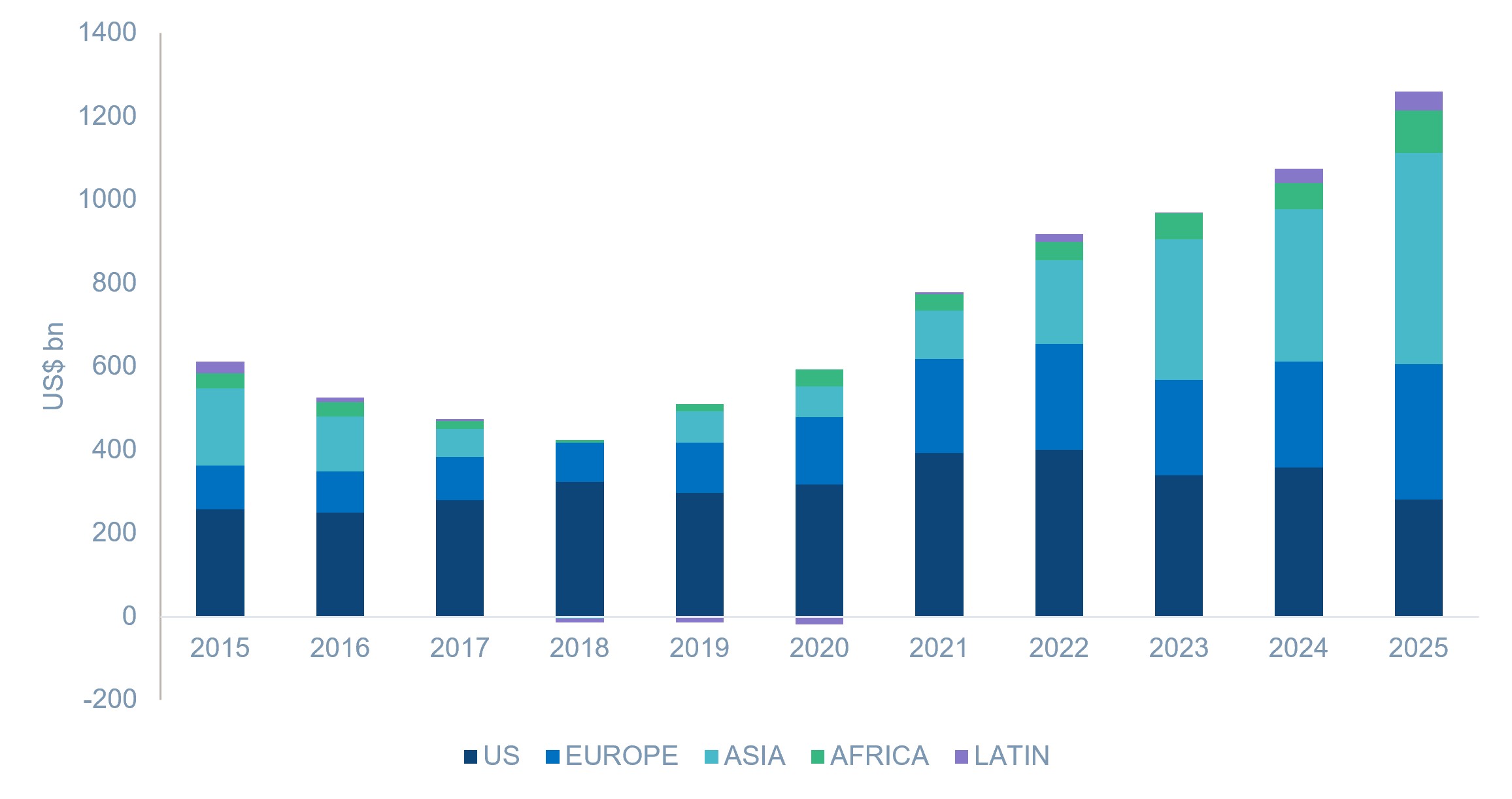
Source: Bloomberg, as of September 4, 2026. Muzinich views and opinions are subject to change. For illustrative purposes only, not to be construed as investment advice or an invitation to engage in any investment activity.
Past performance is not a reliable indicator of current or future results.
References to specific companies is for illustrative purposes only and does not reflect the holdings of any specific past or current portfolio or account.
This material is not intended to be relied upon as a forecast, research, or investment advice, and is not a recommendation, offer or solicitation to buy or sell any securities or to adopt any investment strategy. The opinions expressed by Muzinich & Co. are as of August 28, 2026, and may change without notice. All data figures are from Bloomberg, as of September 4, 2026, unless otherwise stated.
References
[1] Bloomberg, as of September 4, 2026
[2] Goldman Sachs, “Oil Tracker: The Dark Transit Rises; Rolling Our Diesel Hedging Recommendation,” September 2, 2026
[3] Washington Post, “Trump Said His Deal with Venezuela Would Lower Gas Prices. Will It?” September 2, 2026
[4] Bloomberg News, “Carry Trade Exodus Fuels Yen Gain Ahead of BOJ Rate Decision,” September 4, 2026
[5] Bloomberg News, “Yen’s $103 Billion Short Risks Unwind Below 155, JPMorgan Says,” September 3, 2026
[6] Bloomberg, as of September 4, 2026
[7] Bloomberg, as of September 4, 2026
[8] Bloomberg Intelligence, “CHINA REACT: PMIs Show Growth Stuck, Build Stimulus Case,” August 30, 2026
[9] Bloomberg News, “US, China Offer Dueling Views on Ties in Aftermath of G20 Clash,” September 4, 2026
[10] Bloomberg News, “China-US Spat at G20 Largely Came Down to Dispute Over One Word,” September 3, 2026
--------
Important information
Muzinich & Co., “Muzinich” and/or the “Firm” referenced herein is defined as Muzinich & Co. Inc. and its affiliates. This material has been produced for information purposes only and as such the views contained herein are not to be taken as investment advice. Opinions are as of date of publication and are subject to change without reference or notification to you. Past performance is not a reliable indicator of current or future results and should not be the sole factor of consideration when selecting a product or strategy. The value of investments and the income from them may fall as well as rise and is not guaranteed and investors may not get back the full amount invested. Rates of exchange may cause the value of investments to rise or fall. Emerging Markets may be more risky than more developed markets for a variety of reasons, including but not limited to, increased political, social and economic instability, heightened pricing volatility and reduced market liquidity. Any research in this document has been obtained and may have been acted on by Muzinich for its own purpose. The results of such research are being made available for information purposes and no assurances are made as to their accuracy. Opinions and statements of financial market trends that are based on market conditions constitute our judgment and this judgment may prove to be wrong. The views and opinions expressed should not be construed as an offer to buy or sell or invitation to engage in any investment activity, they are for information purposes only. Any forward-looking information or statements expressed in the above may prove to be incorrect. In light of the significant uncertainties inherent in the forward-looking statements included herein, the inclusion of such information should not be regarded as a representation that the objectives and plans discussed herein will be achieved. Muzinich gives no undertaking that it shall update any of the information, data and opinions contained in the above.
United States: This material is for Institutional Investor use only – not for retail distribution. Muzinich & Co., Inc. is a registered investment adviser with the Securities and Exchange Commission (SEC). Muzinich & Co., Inc.’s being a Registered Investment Adviser with the SEC in no way shall imply a certain level of skill or training or any authorization or approval by the SEC.
United Arab Emirates (UAE): This information is provided for discussion and informational purposes only and does not constitute an offer or solicitation in the UAE. It is intended solely for Professional Investors and should not be relied upon by any other person. This material has not been reviewed or approved by the UAE Securities and Commodities Authority, the UAE Central Bank or any other relevant authority. Nothing contained herein constitutes investment, legal, tax or other professional advice. Recipients should make their own independent assessment where appropriate.
Abu Dhabi Global Market (ADGM): This information is provided for discussion and informational purposes only and does not constitute an offer or solicitation in the ADGM. It is intended solely for Professional Clients (as defined by the Financial Services Regulatory Authority) and should not be relied upon by any other person. This material has not been reviewed or approved by the Financial Services Regulatory Authority or any other relevant authority in the UAE.
Issued in the European Union by Muzinich & Co. (Ireland) Limited, which is authorized and regulated by the Central Bank of Ireland. Registered in Ireland, Company Registration No. 307511. Registered address: 32 Molesworth Street, Dublin 2, D02 Y512, Ireland. Issued in Switzerland by Muzinich & Co. (Switzerland) AG. Registered in Switzerland No. CHE-389.422.108. Registered address: Tödistrasse 5, 8002 Zurich, Switzerland. Issued in Singapore and Hong Kong by Muzinich & Co. (Singapore) Pte. Limited, which is licensed and regulated by the Monetary Authority of Singapore. Registered in Singapore No. 201624477K. Registered address: 6 Battery Road, #26-05, Singapore, 049909. Issued in all other jurisdictions (excluding the U.S.) by Muzinich & Co. Limited. which is authorized and regulated by the Financial Conduct Authority. Registered in England and Wales No. 3852444. Registered address: 8 Hanover Street, London W1S 1YQ, United Kingdom.2026-09-07-19330

By clicking "Submit", I am (i) signing up to receive the Opinion Pieces from the "Opinions" page of the Muzinich & Co website, (ii) representing that the above information is true and accurate and (iii) agreeing to join the Muzinich & Co mailing list. I understand that Muzinich & Co will not add retail investors or individuals with personal email addresses to its mailing list and represent that I am not a retail investor. By providing my personal and professional information I am consenting to its use and disclosure in accordance with the Muzinich & Co. Privacy Policy. I understand that I may withdraw my consent and unsubscribe from receiving future communications by clicking "Unsubscribe" from the emails that are sent to me from Muzinich & Co.

Oct 08, 2026
Muzinich Asset Allocation Group Monthly Update - October 2026
Please click to watch our latest Asset Allocation Group video update for the month of September 2026.

Oct 08, 2026
Corporate Credit Snapshot - October 2026
September offered fixed income investors little room to hide, and global credit delivered negative returns as both short- and long-term rates moved higher.

Oct 05, 2026
Muzinich Weekly Market Comment: Europe’s Widening Sovereign Divide
Rising bond yields are exposing growing divergence within European sovereign markets, as fiscal concerns drive spreads wider against Germany. While volatility is also weighing on credit, resilient growth and earnings could create opportunities for selective high-yield investors.