Muzinich Weekly Market Comment: Inflation, Growth, or Sustainability
Insight
October 12, 2026
If you have any feedback on this article or are interested in subscribing to our content, please contact us at opinions@muzinich.com or fill out the form on the right hand side of this page.
--------
It was a quiet week, at least relative to the past five, during which investor fears climbed, prompted by a wholesale reassessment of expectations for the final quarter. At the epicenter was central bank tightening, with investors pushing out their projections for the peak in rates across the globe. At the same time, they abandoned hope that Middle East tensions and the resulting energy shock would fade in the near term. Meanwhile, the conclusion drawn on AI was that the boom would continue, uneven but persistent, at least through the final quarter.
This prompted a broader debate over which risk should dominate the market’s thinking for the quarter ahead. Is the most immediate threat a resurgence in inflation, as physical supply constraints limit the availability of goods, services inflation remains sticky, and geopolitical tensions continue to exert upward pressure on prices? Or will higher financing costs expose vulnerabilities in government balance sheets and test the resilience of property markets, consumers, and corporates?
Or, paradoxically, should our greatest fear be that growth doesn’t weaken but rather accelerates? With fiscal largesse continuing unabated and AI investment appearing relatively insensitive to higher interest rates, should investors be bracing for another blowout earnings season, and for the prospect that stronger-than-expected growth allows policymakers to push rates higher and hold them there for longer?
The US Treasury curve bull flattened modestly this week, driven mainly by a combination of two factors. First, the minutes from September’s Federal Open Market Committee (FOMC) meeting suggested little urgency to raise rates at consecutive meetings, although the committee did see risk tilted toward higher inflation. Second, geopolitical tensions eased slightly, enough to cap crude oil prices, after President Trump posted that the US was having productive discussions with Iran and that “we will not be attacking Iran at any time prior to the Midterm Elections”.[1]
This week’s economic data were largely ignored by markets but continued to paint the now-familiar picture of robust activity alongside persistent price pressures. The Institute for Supply Management (ISM) services index showed activity expanding at a rapid pace, printing 54.9 in September. New orders remained very strong at 59.8, while backlogs rose to 56.6, their highest level since July 2022, pointing to a healthy pipeline of work heading into the fourth quarter. This strength is also feeding through to prices, with the prices paid component climbing to a post-2022 high of 74.0. [2] On the employment front, another decline in weekly initial jobless claims pushed the four-week moving average down to just 198k, its lowest level since September 2022, when the US unemployment rate stood at only 3.5%.
Returning to the debate over what investors should fear most in the US, whether rising inflation, growth, or the sustainability of sovereign and corporate balance sheets, the US Treasury market offers a useful clue. Breaking the 10-year Treasury yield down into its two main components, real yields and inflation break-evens, shows that inflation expectations have been broadly stable over the past five weeks, while real yields have risen sharply, by close to 50bps to 2.80%.
This suggests two things. First, stable break-evens are consistent with expectations that the Federal Reserve will deliver the higher real rates needed to contain inflation. Second, investors are demanding a higher return after inflation, rather than more protection against it. In other words, the market fears the strength of growth, and the real rates required to accommodate it, rather than an inflation scare (see Chart of the Week).
In Europe, by contrast, the curve lightly bear flattened, suggesting that investors there are more focused on the inflation outlook. In a light week for regional data, the final S&P Global Eurozone Composite Purchasing Managers’ Index (PMI) confirmed a strong September, showing a solid expansion at 53.1, up from 52.0 in August and its highest level in nearly three and a half years. Demand was strong, with new orders growing at their fastest pace in 41 months and backlogs of work rising for the first time since June 2022, while input costs and output prices both rose at their fastest rates since May. [3] Meanwhile, the regional producer price index confirmed that pressures are building further up the pipeline, rising 1.9% month-over-month in August and taking the annual rate across the bloc to 8.2%, up from 5.8% in July. Energy was the main driver, but the pressure is broadening, with Italy posting a particularly sharp monthly increase of 3.1%[4].
Also notable was the outperformance of French government bonds over German Bunds at the front end, after Marine Le Pen sought to reassure investors of her fiscal credentials ahead of next spring’s presidential election. She pledged to bring the deficit below 3% within 18 months of taking office, eliminate the primary deficit by the end of 2028, and reduce public spending to below 50% of GDP by the end of her term. She also called on the European Central Bank to intervene to bring down France’s rising borrowing costs. [5] However, the outperformance did not extend to the long end of the curve, suggesting that while investors are comfortable with the near-term outlook, longer-term fiscal sustainability remains a serious concern for France.
Currencies, commodities and equities were largely range-bound this week, with most moves within +/-1%. The exception was Brazil, where the Ibovespa surged more than 8% and the real gained over 4.5% against the dollar. The catalyst was Flávio Bolsonaro’s first-round win on 4 October, taking 47.03% of valid votes against Lula’s 45.16%, a lead no major poll average had predicted. He enters the 25 October runoff as clear favorite, with prediction markets pricing his odds above 80%, and history is on his side: since 1989, Brazil’s first direct presidential election after military rule, the first-round leader has won every runoff. [6]
Perhaps France should take note of Flávio Bolsonaro’s playbook, which proposes the clearest market-oriented shift: a debt-anchored fiscal rule, cutting at least ten ministries, limiting subsidized credit and restarting privatizations. Investors, too, should take note of Latin America’s remarkable political realignment. Some call it a U-turn; it is undoubtedly a shift to the right and toward closer alignment with the US administration. The first domino fell in late 2023, when Argentine voters rejected the Peronist establishment and elected Javier Milei. Ecuador and Bolivia followed, then Chile and Honduras in late 2025. In 2026, Peru elected Keiko Fujimori by the narrowest of margins, and Colombia chose right-wing outsider Abelardo de la Espriella, defying the pollsters. Now, most significantly, Brazil looks set to follow. For investors, this is good news: governments’ underlying DNA is shifting from the social left toward the right, typically meaning a more orthodox and predictable approach to economic management, business-friendly policies that reward merit and renewed US backing from which Argentina has already benefited.
Chart of the Week: Strength of Growth
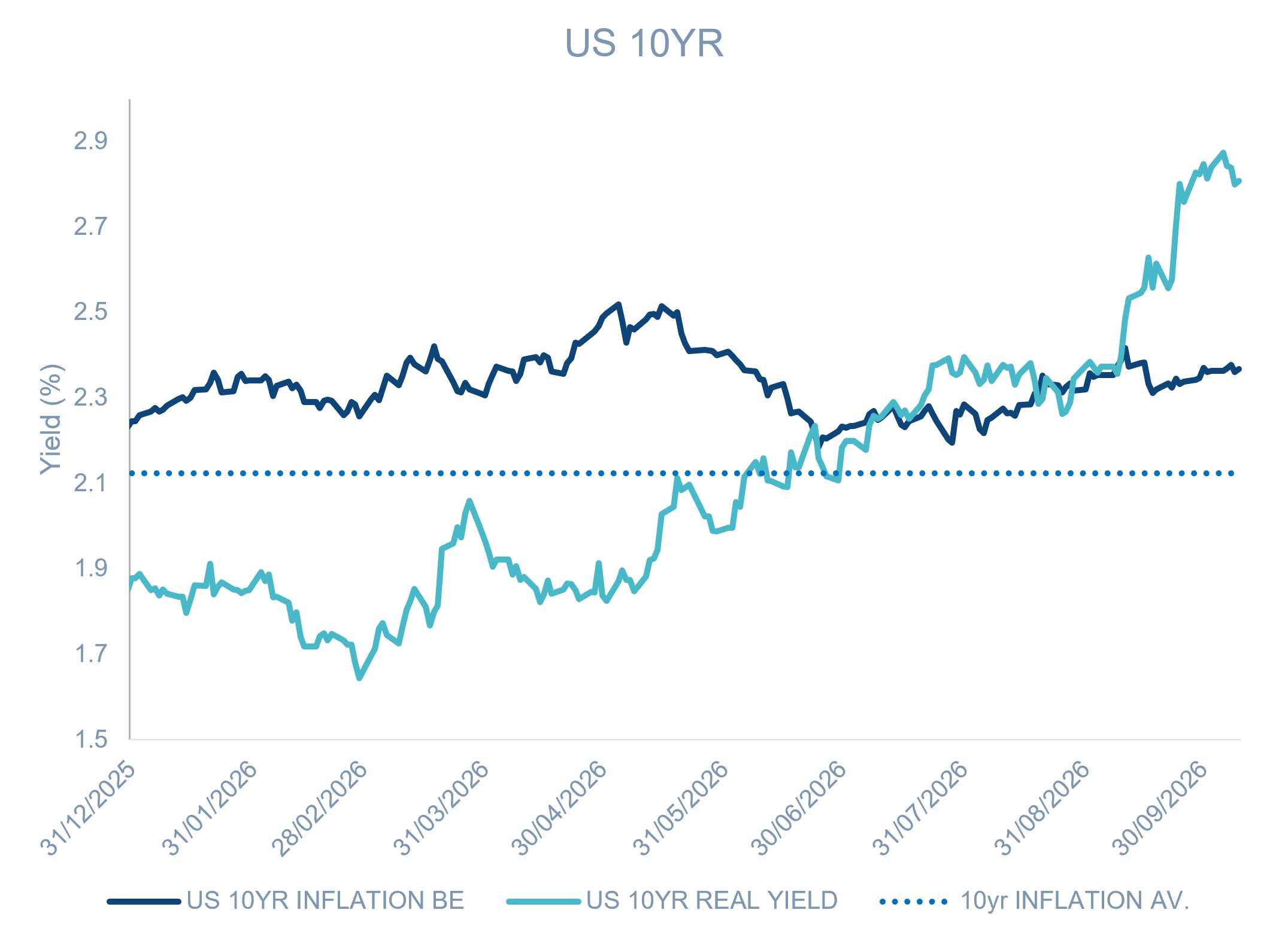
Source: Bloomberg, as of October 9, 2026. Muzinich views and opinions are subject to change. For illustrative purposes only, not to be construed as investment advice or an invitation to engage in any investment activity.
References
[1] Bloomberg, “Trump Says US Will Not Attack Iran Before Nov. 3 Midterms,” October 8, 2026
[2] Bloomberg, “US REACT: Strong Orders, Prices in ISM Services Back Fed Hold,” October 5, 2026
[3] S&P Global Eurozone Composite PMI, October 5, 2026
[4] Eurostat, “Industrial producer prices up by 1.9% in both the euro area and the EU,” October 5, 2026
[5] Bloomberg, “Le Pen Vows to Cut French Deficit, Calls on ECB to Intervene,” October 6, 2026
[6] Goldman Sachs Research, “Brazil General Election: The Right Wins the Night,” October 7, 2026
Past performance is not a reliable indicator of current or future results.
References to specific companies is for illustrative purposes only and does not reflect the holdings of any specific past or current portfolio or account.
This material is not intended to be relied upon as a forecast, research, or investment advice, and is not a recommendation, offer or solicitation to buy or sell any securities or to adopt any investment strategy. The opinions expressed by Muzinich & Co. are as of October 9, 2026, and may change without notice. All data figures are from Bloomberg, as of October 9, 2026, unless otherwise stated.
--------
Important information
Muzinich & Co., “Muzinich” and/or the “Firm” referenced herein is defined as Muzinich & Co. Inc. and its affiliates. This material has been produced for information purposes only and as such the views contained herein are not to be taken as investment advice. Opinions are as of date of publication and are subject to change without reference or notification to you. Past performance is not a reliable indicator of current or future results and should not be the sole factor of consideration when selecting a product or strategy. The value of investments and the income from them may fall as well as rise and is not guaranteed and investors may not get back the full amount invested. Rates of exchange may cause the value of investments to rise or fall. Emerging Markets may be more risky than more developed markets for a variety of reasons, including but not limited to, increased political, social and economic instability, heightened pricing volatility and reduced market liquidity. Any research in this document has been obtained and may have been acted on by Muzinich for its own purpose. The results of such research are being made available for information purposes and no assurances are made as to their accuracy. Opinions and statements of financial market trends that are based on market conditions constitute our judgment and this judgment may prove to be wrong. The views and opinions expressed should not be construed as an offer to buy or sell or invitation to engage in any investment activity, they are for information purposes only. Any forward-looking information or statements expressed in the above may prove to be incorrect. In light of the significant uncertainties inherent in the forward-looking statements included herein, the inclusion of such information should not be regarded as a representation that the objectives and plans discussed herein will be achieved. Muzinich gives no undertaking that it shall update any of the information, data and opinions contained in the above.
United States: This material is for Institutional Investor use only – not for retail distribution. Muzinich & Co., Inc. is a registered investment adviser with the Securities and Exchange Commission (SEC). Muzinich & Co., Inc.’s being a Registered Investment Adviser with the SEC in no way shall imply a certain level of skill or training or any authorization or approval by the SEC.
United Arab Emirates (UAE): This information is provided for discussion and informational purposes only and does not constitute an offer or solicitation in the UAE. It is intended solely for Professional Investors and should not be relied upon by any other person. This material has not been reviewed or approved by the UAE Securities and Commodities Authority, the UAE Central Bank or any other relevant authority. Nothing contained herein constitutes investment, legal, tax or other professional advice. Recipients should make their own independent assessment where appropriate.
Abu Dhabi Global Market (ADGM): This information is provided for discussion and informational purposes only and does not constitute an offer or solicitation in the ADGM. It is intended solely for Professional Clients (as defined by the Financial Services Regulatory Authority) and should not be relied upon by any other person. This material has not been reviewed or approved by the Financial Services Regulatory Authority or any other relevant authority in the UAE.
Issued in the European Union by Muzinich & Co. (Ireland) Limited, which is authorized and regulated by the Central Bank of Ireland. Registered in Ireland, Company Registration No. 307511. Registered address: 32 Molesworth Street, Dublin 2, D02 Y512, Ireland. Issued in Switzerland by Muzinich & Co. (Switzerland) AG. Registered in Switzerland No. CHE-389.422.108. Registered address: Tödistrasse 5, 8002 Zurich, Switzerland. Issued in Singapore and Hong Kong by Muzinich & Co. (Singapore) Pte. Limited, which is licensed and regulated by the Monetary Authority of Singapore. Registered in Singapore No. 201624477K. Registered address: 6 Battery Road, #26-05, Singapore, 049909. Issued in all other jurisdictions (excluding the U.S.) by Muzinich & Co. Limited. which is authorized and regulated by the Financial Conduct Authority. Registered in England and Wales No. 3852444. Registered address: 8 Hanover Street, London W1S 1YQ, United Kingdom.

By clicking "Submit", I am (i) signing up to receive the Opinion Pieces from the "Opinions" page of the Muzinich & Co website, (ii) representing that the above information is true and accurate and (iii) agreeing to join the Muzinich & Co mailing list. I understand that Muzinich & Co will not add retail investors or individuals with personal email addresses to its mailing list and represent that I am not a retail investor. By providing my personal and professional information I am consenting to its use and disclosure in accordance with the Muzinich & Co. Privacy Policy. I understand that I may withdraw my consent and unsubscribe from receiving future communications by clicking "Unsubscribe" from the emails that are sent to me from Muzinich & Co.

Oct 08, 2026
Muzinich Asset Allocation Group Monthly Update - October 2026
Please click to watch our latest Asset Allocation Group video update for the month of September 2026.

Oct 08, 2026
Corporate Credit Snapshot - October 2026
September offered fixed income investors little room to hide, and global credit delivered negative returns as both short- and long-term rates moved higher.

Oct 05, 2026
Muzinich Weekly Market Comment: Europe’s Widening Sovereign Divide
Rising bond yields are exposing growing divergence within European sovereign markets, as fiscal concerns drive spreads wider against Germany. While volatility is also weighing on credit, resilient growth and earnings could create opportunities for selective high-yield investors.