Muzinich Weekly Market Comment: August Lull
Insight
August 17, 2026
If you have any feedback on this article or are interested in subscribing to our content, please contact us at opinions@muzinich.com or fill out the form on the right hand side of this page.
--------
It was a quiet week for financial markets in terms of price action, typical of the seasonal August lull. Earnings season is drawing to a close, the economic data calendar and central bank activity remain relatively light, and the geopolitical impasse in the Middle East continued. 17 August marks the initial 60-day deadline of the Memorandum of Understanding negotiations, although both sides have reportedly indicated their consent to mediators to extend the talks[1].
As we move closer to the six-month mark since the military operation began on 28 February—with no signs of the reopening of the Strait of Hormuz—the latest attempt, the Oman–Iran accord, has seemingly stalled. The US appears to have aggressively shifted tactics, moving clearly away from military action towards full-scale economic pressure. Treasury Secretary Scott Bessent said that the US will soon announce unprecedented economic measures against Iran[2]. Perhaps slightly surprising was the lack of follow-through in energy prices, with both West Texas Intermediate and Brent crude grinding higher by around 3.5%, closing the week close to $81 and $86.50 per barrel, respectively. It is true that the release of strategic reserves and commercial stockpiles is helping—as are volumes bypassing the Strait of Hormuz via pipelines—while China has also slashed its oil imports, which is supportive. But after six months of supply shortfalls, with no likely reopening of the Strait of Hormuz in sight, and both parties setting up for the long game, prediction markets give only a 35% likelihood that traffic through the Strait of Hormuz will return to normal by 1 January 2027, see Chart of the Week[3]. One might have expected crude prices to move significantly higher, or so the oil bulls could argue.
The counterargument is that the oil bulls are factoring in too large a supply disruption/shock. Put another way, the Strait of Hormuz is not actually closed! According to US Energy Secretary Chris Wright, an estimated nearly 9 million barrels per day (bpd) are still moving through it, while total Gulf exports are around 15 million bpd when pipelines are included, compared with roughly 20 million bpd before the war[4]. The discrepancy between the bulls and bears boils down to the inability to now track tankers. There are three problems. First, nearly all vessels have gone dark, switching off their Automatic Identification Systems (AIS). Second, most satellite-imagery vendors, under pressure from Washington, have stopped selling their pictures. Third, rather than travelling from origin to destination in a single voyage, most cargo flows now involve ship-to-ship transfers on the high seas. This allows smaller vessels to navigate the Strait of Hormuz more easily, as they are harder to identify and easier to escort under US military protection before transferring their cargo to larger crude carriers.
So, the real debate should be how much oil is finding an exit. If we use Chris Wright’s estimate as the optimistic end of the spectrum and compare it with the countable data—Kpler puts the five-day average of ship transits through Hormuz at around 13—we can safely say that at least 5 million bpd are transiting the Strait.4. This gives us a reasonable estimated range of 5–9 million bpd.
This still leaves a shortfall, but it may help explain the reluctance of oil prices to spike higher. It also provides some grounds for confidence that the US shift in tactics may have time to bear fruit before the global oil inventory cushion is depleted to critical levels.
Government bonds also largely ignored the grind higher in oil prices, with European bonds showing all the signs of an August holiday, trading in a tight range over the week. In the US, inflation data came in soft, suggesting little inflationary follow-through from the macro backdrop. Consumer price inflation in July fell to 3.4% year-over-year (YoY), rising by just 0.07% over the month, while core consumer prices fell to 1.6% on a three-month annualized basis[5]. Wholesale prices also cooled, with the Producer Price Index rising 4.7% YoY, down from 5.5% in June[6].
This led to a steepening of the US curve, as front-end yields fell and investors pulled back the odds of the Federal Open Market Committee hiking in September to 30%[7]. Meanwhile, the long end closed the week relatively unchanged with supply possibly weighing on sentiment following the $25 billion 30-year Treasury auction, which was awarded at 5.216%—the highest yield the US government has printed for a 30-year bond since 2001[8]!
Corporate credit markets continued to grind higher, with the status quo restored. High yield, benefiting from its superior coupon, continued to outperform its investment-grade peers. With major currencies and equity markets largely August range-bound within a ±1% range over the week, the Bloomberg World Large & Mid Cap Index closely around 0.5% higher for the week.
Chart of the Week: Odds Against a Near Term Solution
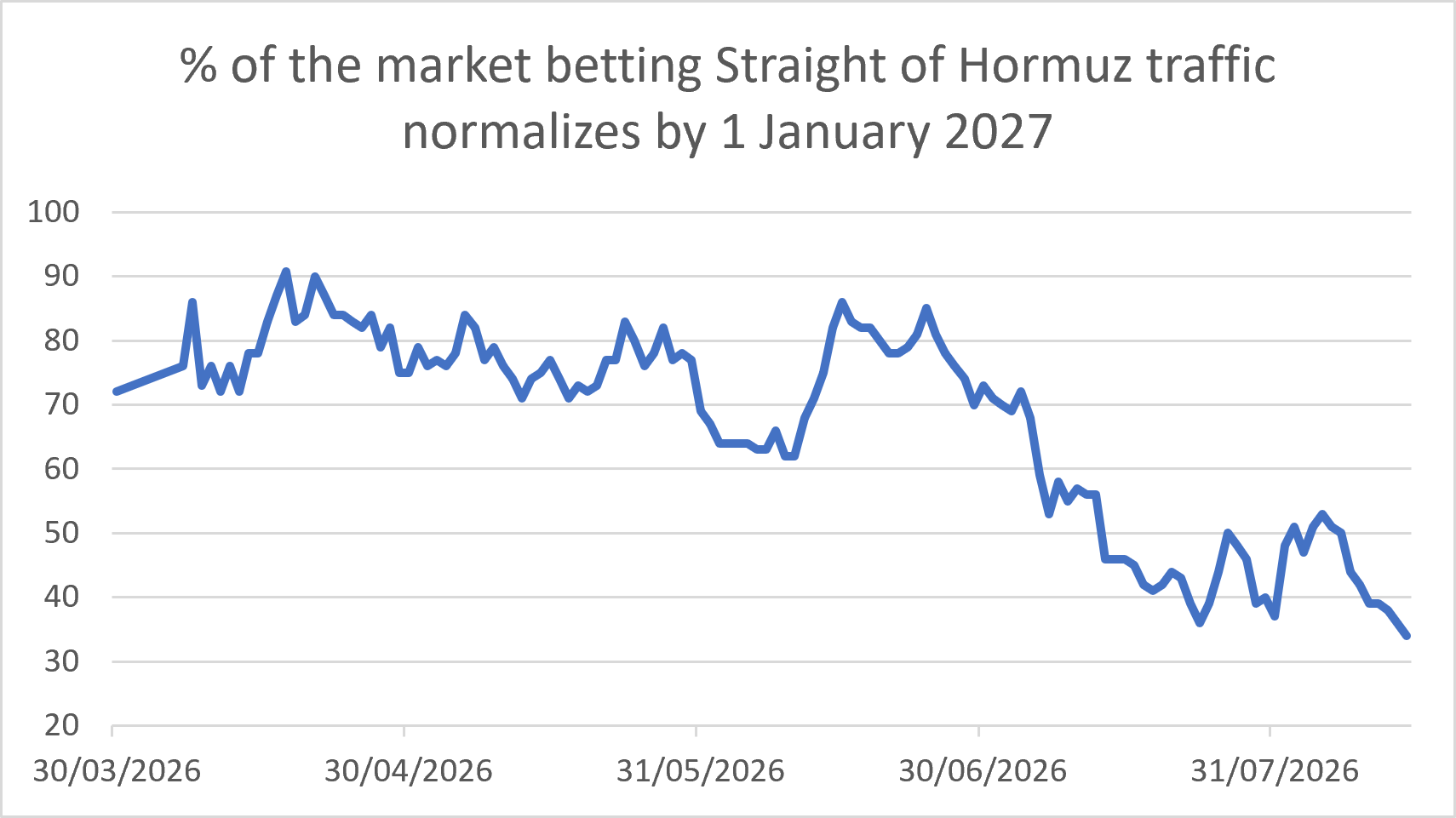
Source: Bloomberg, as of August 14, 2026. Muzinich views and opinions are subject to change. For illustrative purposes only, not to be construed as investment advice or an invitation to engage in any investment activity.
References
[1] Midde East Monitor, “US, Iran agree to extend 60-day ceasefire ahead of Aug. 17 deadline,” August 12, 2026
[2] Bloomberg, “US Readies Unprecedented ‘Economic Isolation’ Plan for Iran,” August 14, 2026
[3] Bloomberg, as of August 14, 2026
[4] CNBC, “Strait of Hormuz ship traffic near three-month low as U.S.-Iran deal in doubt,” August 12, 2026
[5] Bloomberg, “US REACT: Modest Core CPI Lowers Fed Rate-Hike Chances,” August 12, 2026
[6] Bloomberg, “US Wholesale Inflation Cools as War-Driven Energy Shock Fades,” August 13, 2026
[7] Bloomberg, as of August 14, 2026
[8] Bloomberg First Word,” US 30-Year Auction Tails as It Draws Highest Yield Since 2001,” August 13, 2026
Past performance is not a reliable indicator of current or future results.
References to specific companies is for illustrative purposes only and does not reflect the holdings of any specific past or current portfolio or account.
This material is not intended to be relied upon as a forecast, research, or investment advice, and is not a recommendation, offer or solicitation to buy or sell any securities or to adopt any investment strategy. The opinions expressed by Muzinich & Co. are as of August 14, 2026, and may change without notice. All data figures are from Bloomberg, as of August 14, 2026, unless otherwise stated.
--------
Important Information
Muzinich & Co., “Muzinich” and/or the “Firm” referenced herein is defined as Muzinich & Co. Inc. and its affiliates. This material has been produced for information purposes only and as such the views contained herein are not to be taken as investment advice. Opinions are as of date of publication and are subject to change without reference or notification to you. Past performance is not a reliable indicator of current or future results and should not be the sole factor of consideration when selecting a product or strategy. The value of investments and the income from them may fall as well as rise and is not guaranteed and investors may not get back the full amount invested. Rates of exchange may cause the value of investments to rise or fall. Emerging Markets may be more risky than more developed markets for a variety of reasons, including but not limited to, increased political, social and economic instability, heightened pricing volatility and reduced market liquidity. Any research in this document has been obtained and may have been acted on by Muzinich for its own purpose. The results of such research are being made available for information purposes and no assurances are made as to their accuracy. Opinions and statements of financial market trends that are based on market conditions constitute our judgment and this judgment may prove to be wrong. The views and opinions expressed should not be construed as an offer to buy or sell or invitation to engage in any investment activity, they are for information purposes only. Any forward-looking information or statements expressed in the above may prove to be incorrect. In light of the significant uncertainties inherent in the forward-looking statements included herein, the inclusion of such information should not be regarded as a representation that the objectives and plans discussed herein will be achieved. Muzinich gives no undertaking that it shall update any of the information, data and opinions contained in the above.
United Arab Emirates (UAE): This information is provided for discussion and informational purposes only and does not constitute an offer or solicitation in the UAE. It is intended solely for Professional Investors and should not be relied upon by any other person. This material has not been reviewed or approved by the UAE Securities and Commodities Authority, the UAE Central Bank or any other relevant authority. Nothing contained herein constitutes investment, legal, tax or other professional advice. Recipients should make their own independent assessment where appropriate.
Abu Dhabi Global Market (ADGM): This information is provided for discussion and informational purposes only and does not constitute an offer or solicitation in the ADGM. It is intended solely for Professional Clients (as defined by the Financial Services Regulatory Authority) and should not be relied upon by any other person. This material has not been reviewed or approved by the Financial Services Regulatory Authority or any other relevant authority in the UAE.
United States: This material is for Institutional Investor use only – not for retail distribution. Muzinich & Co., Inc. is a registered investment adviser with the Securities and Exchange Commission (SEC). Muzinich & Co., Inc.’s being a Registered Investment Adviser with the SEC in no way shall imply a certain level of skill or training or any authorization or approval by the SEC.
Issued in the European Union by Muzinich & Co. (Ireland) Limited, which is authorized and regulated by the Central Bank of Ireland. Registered in Ireland, Company Registration No. 307511. Registered address: 32 Molesworth Street, Dublin 2, D02 Y512, Ireland. Issued in Switzerland by Muzinich & Co. (Switzerland) AG. Registered in Switzerland No. CHE-389.422.108. Registered address: Tödistrasse 5, 8002 Zurich, Switzerland. Issued in Singapore and Hong Kong by Muzinich & Co. (Singapore) Pte. Limited, which is licensed and regulated by the Monetary Authority of Singapore. Registered in Singapore No. 201624477K. Registered address: 6 Battery Road, #26-05, Singapore, 049909. Issued in all other jurisdictions (excluding the U.S.) by Muzinich & Co. Limited. which is authorized and regulated by the Financial Conduct Authority. Registered in England and Wales No. 3852444. Registered address: 8 Hanover Street, London W1S 1YQ, United Kingdom.

By clicking "Submit", I am (i) signing up to receive the Opinion Pieces from the "Opinions" page of the Muzinich & Co website, (ii) representing that the above information is true and accurate and (iii) agreeing to join the Muzinich & Co mailing list. I understand that Muzinich & Co will not add retail investors or individuals with personal email addresses to its mailing list and represent that I am not a retail investor. By providing my personal and professional information I am consenting to its use and disclosure in accordance with the Muzinich & Co. Privacy Policy. I understand that I may withdraw my consent and unsubscribe from receiving future communications by clicking "Unsubscribe" from the emails that are sent to me from Muzinich & Co.