Muzinich Weekly Market Comment: Always Look on the Bright Side of Life
Insight
October 26, 2026
If you have any feedback on this article or are interested in subscribing to our content, please contact us at opinions@muzinich.com or fill out the form on the right hand side of this page.
--------
The third week of the month is usually a dull affair, with little economic data to analyze, and this one was quieter still. The Federal Open Market Committee (FOMC) was in its blackout period ahead of this week’s meeting, many corporations were in theirs ahead of Q3 results, the new UK government was busy preparing a much-anticipated first Autumn Budget, and the US Administration was deep in midterm campaign mode.
That left the market to its own imagination, and with Monday marking 39 years to the day since Black Monday (19 October 1987, when the Dow fell 22.6% in a single session), perhaps it is no surprise that sentiment started on the back foot and deteriorated as the week progressed. Investors, it seemed, saw no reason to settle for a single fear when they could multiply them all! Inflation worries, stoked by rising energy prices, were multiplied by a growth scare, itself the product of investors’ continued pushback on rising capex forecasts. Compounding it all was the dreaded question of sustainability, as funding costs shifted higher again.
The result was a classic flight to quality. Safe-haven government bonds rallied, notably US Treasuries and German Bunds, while sovereigns with weaker fiscal positions came under pressure, with the closely watched France–Germany 10-year spread breaching 170 basis points (bps), roughly 20 bps shy of its 2011 peak at the height of the euro-area debt crisis. Credit spreads widened, with high yield underperforming. In FX, the Swiss franc and the yen appreciated, while emerging market (EM) currencies underperformed. And at the bottom of the capital structure, equities fared the worst, with technology remaining the epicenter of the sell-off.
If that were not bad enough, next week marks the anniversary of 28 October 1929, the original Black Monday and one of the darkest days of the Wall Street Crash, often cited as the trigger for the Great Depression. With momentum like this, it would not be difficult to list all the reasons to stay bearish and argue that the worst is still to come. Indeed, our inboxes are no doubt full of doom-laden letters, bearish articles and “I told you so” headlines. So, this week we have challenged ourselves to “look on the bright side,” pass up the easy option, go against the grain of the consensus, and pick out the positive developments.
At first glance, the geopolitical backdrop looks as bad as ever. The US and Israel are reported to have drawn up plans for renewed strikes on Iran after the midterms, with its energy infrastructure among the likely targets, [1] while Houthi attacks on Saudi oil fields and airports continue unabated. Yet behind all the noise, oil is flowing. Persian Gulf oil exports have climbed back above prewar levels, averaging more than 24m barrels per day (b/d) in the week to 18 October against 23.3m b/d before the war, [2] helped by a makeshift shipping corridor under US protection and greater use of Saudi and Emirati pipelines that bypass Hormuz. That raises the question of why Brent is still above US$110 per barrel (bbl). The answer lies largely in the cost of getting oil to market. By one estimate, the global average crude freight rate has jumped to more than US$20/bbl from US$3/bbl a year ago. [3] About a third of the increase is attributed to the war risk premium. Much of the rest comes from the costs associated with ship-to-ship transfers outside the Gulf, higher marine fuel prices and tighter tanker availability, as the blockade of Iran’s fleet has pushed up demand for non-sanctioned vessels.
With supply largely normalized, any positive turn of events could easily knock US$20/bbl off crude prices, and two elections in quick succession could change the picture. Israel holds its general election on Tuesday 27th October, and the US goes to the polls for the midterms a week later, on 3rd November. Prediction markets put the chance of Democrats taking the Senate at around two-thirds, [4] while Israeli polls point to a hung parliament, with Eisenkot’s Yashar ahead of Netanyahu’s Likud in each of the latest major surveys but neither bloc close to the 61 seats needed for a majority.[5] What if both leaders emerge from these elections with less room to maneuver?
Add to that the squeeze on Iran’s finances. For most of the conflict, Tehran could fall back on oil parked on tankers off Asia, which it sold to China. However, those barrels ran out in October, with the US naval blockade preventing any replenishment. [6] Perhaps the more likely outcome in November, then, is not escalation but a renewed urgency on all sides to compromise and return to the table to negotiate a peace settlement.
Perhaps less noticed, understandably after four years of false dawns, were some encouraging developments in the Russia–Ukraine war. Talks in Oslo on 20th October between Zelensky, US envoy Steve Witkoff and the Finnish and Norwegian leaders made what Finland’s President Stubb called “genuine progress”.[7] The Kremlin says Putin has since agreed to resume three-way talks with Kyiv and Washington, and he has reportedly proposed a summit with Trump and Xi next month. Meanwhile, Washington has reportedly floated the idea of Europe resuming purchases of Russian gas as an incentive for Moscow to end the war. [8] That would bring much-needed relief to European gas prices, which are above €90 per megawatt-hour (MWh) for the first time since December 2022 as concerns rise over storage, now at record low levels for the time of year. Closer to home, the UK approved the long-delayed Jackdaw North Sea gas field, which should lift domestic gas production by around 6%, easing the country’s reliance on imports. [9]
On the economic front, China, the world’s second-largest economy, unexpectedly revved its growth engine in the third quarter. GDP rose 4.5% year-over-year (YoY), up from 4.3% in Q2 2026 and ahead of consensus. The timelier September activity data firmed too. Industrial production accelerated to 5.5% YoY from 5.2%, retail sales growth more than doubled to 1.1% from 0.4%, and the monthly decline in new home prices moderated further, from 0.17% in August to 0.14% in September. With measured stimulus and strong exports in support, growth momentum should carry into the final quarter. [10]
When it comes to AI, nobody is questioning demand. The debate is over the economics of supplying it, both the cost and the time it takes, as this week’s third-quarter earnings made clear. SpaceX delivered a blowout quarter, with revenue of US$14.6bn comfortably ahead of consensus and its AI business up 830% YoY to US$7.6bn, overtaking Starlink. [11] Elon Musk said SpaceX could rent out its compute “several times over” and expects the shortage to persist for a long time. [12]
Perhaps the clearest indicator of demand, though, is the cost of renting a graphics processing unit (GPU). According to pricing indices, a Blackwell B200 now costs US$6.29 an hour, a 12-month high and around 30% more than a year ago, and even the older H100 is up more than 40% to US$2.88. [13] Perhaps more notable, and overlooked amid poor sentiment, is that funding remains broadly available. The bulk of the build-out is being led by investment grade hyperscalers that can still borrow at around 150 bps over Treasuries. Capital is becoming more selective, which is healthy, but it is far from unavailable, and most projects are going ahead as scheduled.
It is early days in the third-quarter earnings season, but sentiment could get a nice lift over the coming days. Companies making up roughly 47% of the S&P 500’s index weight report in the five sessions from 28 October to 3 November. Consensus coming into the season projects earnings per share (EPS) growth of around 27% YoY, the highest expectation since 2010 outside the second quarter and the pandemic-recovery quarters. Although the bar to beat may be higher, the track record suggests otherwise, with earnings growth exceeding pre-season consensus in 19 of the last 20 quarters. 13
In Europe, the outlook has also improved, with the latest forecasts showing that companies in the benchmark STOXX 600 index are expected to report quarterly earnings growth of 21.9% on average, the second-best growth rate in the past four years. Excluding the energy sector, the rest of the STOXX 600 is expected to book decent gains of 8.4% on average. As for Europe’s blue-chip companies, third-quarter revenue growth is now forecast at 13.3% YoY, which would mark the best showing since the third quarter of 2022. [14]
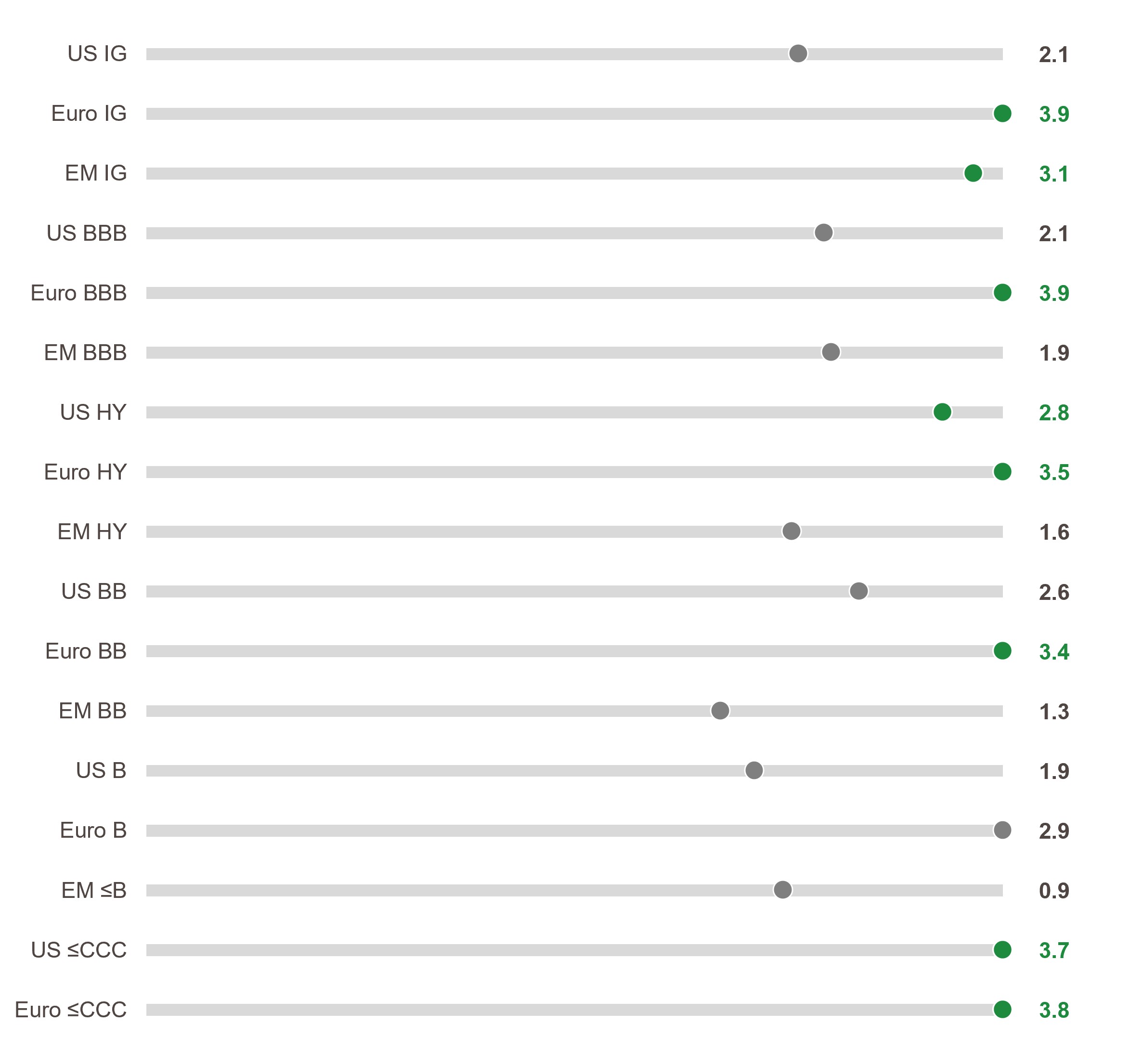
From a valuation perspective, one of the most common pushbacks from clients in our area of expertise over the past few years has been that corporate credit spreads are too tight, and the asset class therefore expensive. There should be no such pushback now. Our preferred valuation tool, the one-year Z-score, is flashing green, with EM and European investment grade at +3 and US high yield also three standard deviations cheap. We favour a one-year timeframe because spreads tend to mean-revert within 12 months unless there is a thematic macro shift, and that is not our base case given solid corporate earnings growth, healthy balance sheets, low defaults and ready access to funding. To put this into perspective, statistically a move of three standard deviations in either direction should occur just 0.3% of the time (see Chart of the Week).
Finally, are there signs that the excess in positioning is being cleaned up? Hedge funds have been aggressive net sellers of global tech, cutting exposure at the fastest pace in Goldman Sachs’ prime brokerage data going back to 2016, although tech still makes up 23.5% of the book. [15] Gold may also offer some confirmation of position adjustment. It fell around 3% this week, which looks counterintuitive for a flight-to-quality asset but is often a feature of the late capitulation phase of a sell-off. When sharp equity drawdowns trigger margin calls, gold’s liquidity makes it one of the first assets sold to raise cash. And if there is one thing investors can look forward to, it is November’s seasonality. Over the past decade, November has been the best month of the year for the S&P 500, with only one negative November during that time. It has been a similar story for corporate credit, where November has been the second-best month over the last ten years, just behind December.
Chart of the Week: 12-month Z-scores—Credit is Cheap
Grey bar = each index’s 1-year spread range, tightest (left) to widest (right). Dot = current spread. Number = 1-year Z-score. Green = Z-score of 3 or more, plus US HY at 93% of its range.
Source: Bloomberg, as of October 26, 2026. Muzinich views and opinions are subject to change. For illustrative purposes only, not to be construed as investment advice or an invitation to engage in any investment activity.
Past performance is not a reliable indicator of current or future results.
References to specific companies is for illustrative purposes only and does not reflect the holdings of any specific past or current portfolio or account.
This material is not intended to be relied upon as a forecast, research, or investment advice, and is not a recommendation, offer or solicitation to buy or sell any securities or to adopt any investment strategy. The opinions expressed by Muzinich & Co. are as of October 23, 2026, and may change without notice. All data figures are from Bloomberg, as of October 23, 2026, unless otherwise stated.
References
[1] Investing.com, “U.S., Israel prepare for renewed Iran strikes after midterm elections—NYTimes,” October 21, 2026
[2] AL-Monitor, “Gulf oil exports surpass prewar levels despite escalating tanker attacks,” October 21, 2026
[3] Goldman Sachs, “High Freight Costs: Wide Crude Differentials, High Product Prices,” October 20, 2026
[4] Bloomberg, as of October 23, 2026
[5] The Jerusalem Post, ”Yashar ahead of Likud in election polls, but Knesset majority still out of reach for both – poll,” October 21, 2026
[6] Taegan Goddard’s Political Wire, “Iran’s Fleet of Shadow Tankers Has Run Out of Oil,” October 21, 2026
[7] Yle, “President Stubb heralds ‘good day for peace’ after Oslo summit,” October 21, 2026
[8] Benzinga, “Trump Envoys Float Russian Gas Comeback for Europe as Part of Ukraine Peace Deal: Report,” October 18, 2026
[9] Energy-pedia News, “UK: Energy Secretary green lights Jackdaw gas field, as Chancellor announces new Energy Wealth Fund,” October 21, 2026
[10] Bloomberg, “CHINA REACT: Stimulus Secures 2026 Goal, Focus Turns to 2027,” October 19, 2026
[11] Yahoo! Finance, “SpaceX Just Reported a 161% Jump in Quarterly Revenue. Wall Street Analysts Were Off by $1.6 Billion as Stock Soars 9%,” October 21, 2026
[12] Constellation Research, “SpaceX's Q3: Musk says it could rent out its AI compute several times over,” October 20, 2026
[13] Citadel, “October Update: Fundamentals in Focus,” October 14, 2026
[14] Global Banking & Finance Review, “European corporate earnings set to get a boost from energy windfall,” October 22, 2026
[15] Goldman Sachs Global Banking & Markets prime brokerage data, Bloomberg, “Hedge Funds Cut Tech at Fastest Pace in a Decade, Goldman Says,” October 19, 2026
--------
Important Information
Muzinich & Co., “Muzinich” and/or the “Firm” referenced herein is defined as Muzinich & Co. Inc. and its affiliates. This material has been produced for information purposes only and as such the views contained herein are not to be taken as investment advice. Opinions are as of date of publication and are subject to change without reference or notification to you. Past performance is not a reliable indicator of current or future results and should not be the sole factor of consideration when selecting a product or strategy. The value of investments and the income from them may fall as well as rise and is not guaranteed and investors may not get back the full amount invested. Rates of exchange may cause the value of investments to rise or fall. Emerging Markets may be more risky than more developed markets for a variety of reasons, including but not limited to, increased political, social and economic instability, heightened pricing volatility and reduced market liquidity. Any research in this document has been obtained and may have been acted on by Muzinich for its own purpose. The results of such research are being made available for information purposes and no assurances are made as to their accuracy. Opinions and statements of financial market trends that are based on market conditions constitute our judgment and this judgment may prove to be wrong. The views and opinions expressed should not be construed as an offer to buy or sell or invitation to engage in any investment activity, they are for information purposes only. Any forward-looking information or statements expressed in the above may prove to be incorrect. In light of the significant uncertainties inherent in the forward-looking statements included herein, the inclusion of such information should not be regarded as a representation that the objectives and plans discussed herein will be achieved. Muzinich gives no undertaking that it shall update any of the information, data and opinions contained in the above.
United States: This material is for Institutional Investor use only – not for retail distribution. Muzinich & Co., Inc. is a registered investment adviser with the Securities and Exchange Commission (SEC). Muzinich & Co., Inc.’s being a Registered Investment Adviser with the SEC in no way shall imply a certain level of skill or training or any authorization or approval by the SEC.
United Arab Emirates (UAE): This information is provided for discussion and informational purposes only and does not constitute an offer or solicitation in the UAE. It is intended solely for Professional Investors and should not be relied upon by any other person. This material has not been reviewed or approved by the UAE Securities and Commodities Authority, the UAE Central Bank or any other relevant authority. Nothing contained herein constitutes investment, legal, tax or other professional advice. Recipients should make their own independent assessment where appropriate.
Abu Dhabi Global Market (ADGM): This information is provided for discussion and informational purposes only and does not constitute an offer or solicitation in the ADGM. It is intended solely for Professional Clients (as defined by the Financial Services Regulatory Authority) and should not be relied upon by any other person. This material has not been reviewed or approved by the Financial Services Regulatory Authority or any other relevant authority in the UAE.
Issued in the European Union by Muzinich & Co. (Ireland) Limited, which is authorized and regulated by the Central Bank of Ireland. Registered in Ireland, Company Registration No. 307511. Registered address: 32 Molesworth Street, Dublin 2, D02 Y512, Ireland. Issued in Switzerland by Muzinich & Co. (Switzerland) AG. Registered in Switzerland No. CHE-389.422.108. Registered address: Tödistrasse 5, 8002 Zurich, Switzerland. Issued in Singapore and Hong Kong by Muzinich & Co. (Singapore) Pte. Limited, which is licensed and regulated by the Monetary Authority of Singapore. Registered in Singapore No. 201624477K. Registered address: 6 Battery Road, #26-05, Singapore, 049909. Issued in all other jurisdictions (excluding the U.S.) by Muzinich & Co. Limited. which is authorized and regulated by the Financial Conduct Authority. Registered in England and Wales No. 3852444. Registered address: 8 Hanover Street, London W1S 1YQ, United Kingdom.

Oct 08, 2026
Corporate Credit Snapshot - October 2026
September offered fixed income investors little room to hide, and global credit delivered negative returns as both short- and long-term rates moved higher.

Oct 08, 2026
Muzinich Asset Allocation Group Monthly Update - October 2026
Please click to watch our latest Asset Allocation Group video update for the month of September 2026.

Jun 11, 2026
Business Development Companies (BDCs) offer a distinctive way to access U.S. middle-market private credit through publicly traded securities, combining exposure to private lending markets with the transparency and liquidity characteristics of listed vehicles. Please click to listen to our latest Muzinich Podcast with Ji He Portfolio Manager for our BDC Strategies where she discusses the ABC of BDCs.